
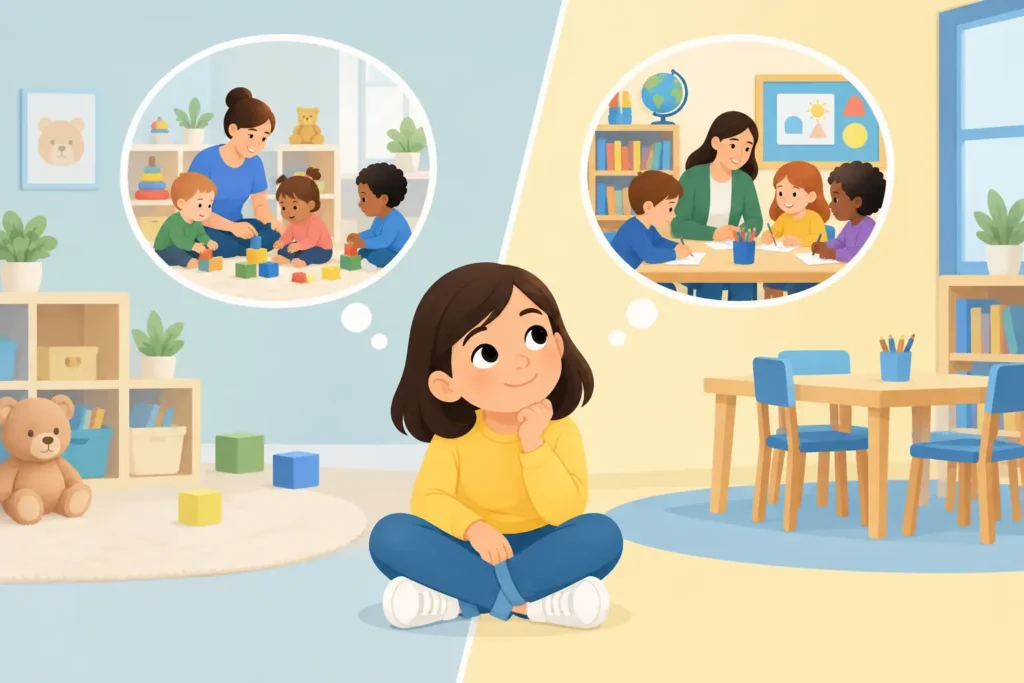
A child who happily sings the alphabet at breakfast may still cling to your hand at the classroom door. Another may be eager for friends and stories but need time to manage a full school day. When parents consider nursery versus kindergarten, the question is not simply which program comes first. It is about finding the setting where your child can feel safe, understood, and ready to grow.
For families, especially those balancing busy work schedules with a young child’s needs, the right choice should offer more than a place to spend the day. It should give children warm relationships, meaningful play, gentle routines, and chances to build the confidence that makes future learning feel exciting rather than overwhelming.
Nursery versus kindergarten: the main difference
Nursery usually serves younger children, often from around age two to four, although age ranges vary by school and local guidelines. Its focus is on helping children become comfortable away from home while building the everyday skills that support independence. Children learn through songs, sensory play, stories, movement, art, and simple group activities.
Kindergarten generally serves older preschool-age children, often around four to six. It builds on those early foundations with more structured learning in language, early reading, writing, math, science, and problem-solving. A thoughtful kindergarten program still makes room for play. At this age, play is not a break from learning. It is often how children test ideas, practice language, negotiate with friends, and discover what they can do.
The labels can differ from one school or country to another, so it is wise to look beyond the name of the program. Ask what a typical day looks like, how educators support different developmental stages, and whether children have time to move, explore, rest, and connect.
What children gain in nursery
Nursery is often a child’s first regular experience in a wider community. That transition can be a big one. A nurturing nursery classroom helps children learn that adults outside their family can be trusted and that a day away from home can still feel secure and joyful.
Much of the learning happens in small but meaningful moments. A child waits for a turn with a favorite toy, puts a cup back after snack, tells a teacher they need help, or comforts a friend who is upset. These experiences strengthen communication, self-control, empathy, and independence.
A good nursery program does not rush children into worksheets or expect them to sit still for long periods. Young children need to use their hands, bodies, and imaginations. They may sort shells by size, mix colors at an easel, build a bridge with blocks, listen to a repeated story, or hunt for leaves outdoors. These activities develop vocabulary, coordination, curiosity, and early thinking skills without making learning feel like pressure.
For a child who is still developing speech, confidence, or comfort in groups, nursery can provide a gentle and supportive starting point. Experienced educators observe each child closely and offer reassurance without taking over. Over time, a child who once watched from the side may begin to join a song, answer a question, or invite another child into play.
What children gain in kindergarten
Kindergarten adds greater purpose and structure while protecting the wonder of early childhood. Children begin to connect letters with sounds, recognize patterns and numbers, listen for longer stretches, and express ideas through speaking, drawing, and early writing. They also learn to follow multi-step directions, complete simple projects, and care for shared materials.
The strongest programs make these skills meaningful. Instead of memorizing facts in isolation, children might make floating boats and talk about why some materials stay on the surface. They may observe water vapor, create geometric forms, bake together, or prepare pizza or sushi while practicing counting, sequencing, cooperation, and new vocabulary.
Reading development deserves particular care during kindergarten. Children benefit from daily read-aloud time, conversations about stories, sound games, and opportunities to see themselves as readers. The goal is not for every child to progress at the exact same pace. The goal is to build a positive relationship with books and give each child the support needed to grow.
Kindergarten also helps children prepare emotionally for primary school. They practice speaking up respectfully, working with classmates, managing disappointment, and trying again when something is difficult. These are not extras. A child who can ask for help, recover from a mistake, and treat others with kindness carries valuable strengths into every future classroom.
How to know which setting is right now
Age matters, but readiness matters too. Some children are eager for a more structured day before they reach a particular age. Others may be bright and curious but need more time to settle into group routines. Neither path is a problem. Children develop in their own ways, and the best decision responds to the child in front of you.
Consider how your child manages short separations, transitions, and time with other children. Can they communicate basic needs? Do they enjoy being read to, singing, building, or pretend play? Are they beginning to show interest in letters, marks on paper, numbers, or asking many questions about how things work? These signs can help you understand what kind of support will feel most comfortable.
Practical family needs matter as well. Working parents may need reliable extended care before or after class, nutritious meals, a safe rest routine, and clear communication from educators. These supports are part of quality care, not an afterthought. When parents know their child is cared for warmly throughout the day, they can focus on work with greater peace of mind.
Look for learning that feels warm and purposeful
Whether you choose nursery or kindergarten, the classroom environment matters as much as the curriculum. Young children learn best when they feel secure enough to explore. Look for educators who greet children warmly, speak to them with respect, and notice when someone needs encouragement or a quiet moment.
Ask how the school balances guided activities with child-led play. A full schedule can look impressive on paper, but children also need unhurried time to build, imagine, ask questions, and follow an interest. Outdoor play deserves a place in the day too. Running, climbing, digging, and observing nature help develop strong bodies, focused minds, and a healthy sense of freedom.
It is also helpful to ask how the school supports character development. Children are learning more than letters and numbers. They are learning how to be a friend, how to care for living things, how to use kind words, and how to respect themselves and others. These lessons become most powerful when they are woven naturally into daily life.
At Summer Tots, children are encouraged to learn with happy hearts and healthy minds through play, practical projects, outdoor discovery, reading, and caring guidance. The aim is not to make childhood feel like a race. It is to help each child become confident, curious, and ready for the next step.
A conversation with educators can bring clarity
A school visit can tell you more than a brochure ever could. Notice whether the children appear engaged and comfortable. Listen to how teachers speak to them. Look for spaces that invite both active play and calm concentration, and ask how the team shares progress or concerns with parents.
You may also want to ask how teachers handle tears at drop-off, conflicts between friends, toilet-learning needs, food preferences, and children who need extra encouragement with language or early literacy. Caring answers usually sound specific. They show that educators see children as individuals, not as a single group moving at the same speed.
The right program will feel like a partnership. You know your child best, while skilled educators bring experience, observation, and thoughtful guidance. Together, you can create a beginning where your child feels safe to take small brave steps, make new friends, and discover the pleasure of learning.