
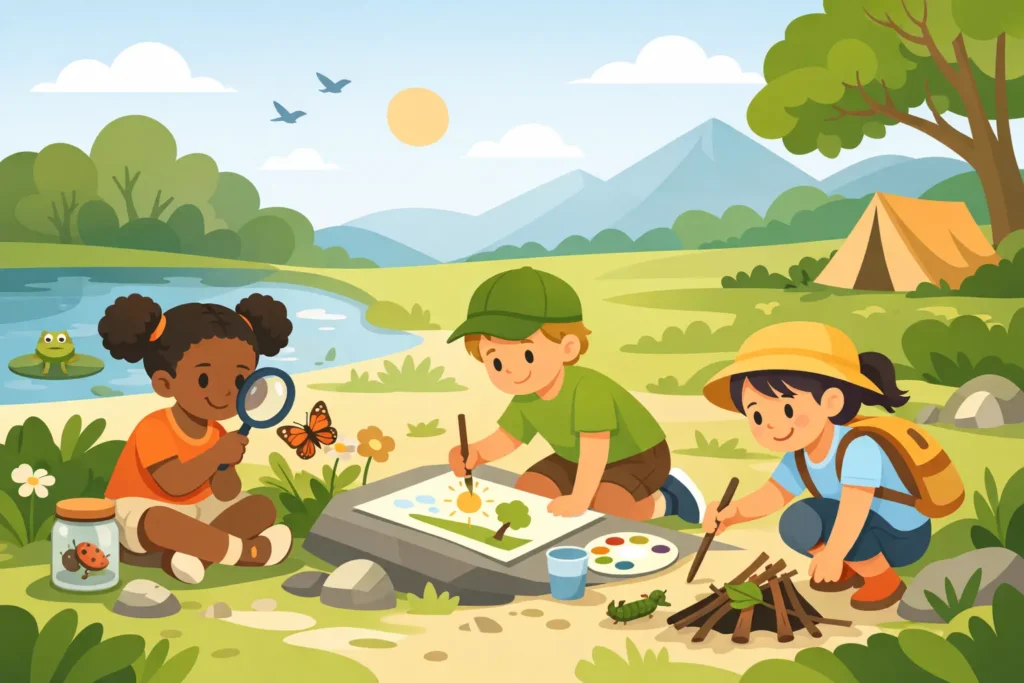
A puddle after rain, an ant carrying a crumb, a seed tucked into soil – these small moments can hold a preschooler’s full attention. Outdoor learning activities for preschoolers turn that natural excitement into meaningful growth. Children move their bodies, ask questions, practice words, solve little problems, and learn that the world is a wonderful place to explore.
For busy families, outdoor time does not need to mean a complicated outing or expensive equipment. A safe school yard, a nearby green space, or even a shaded patio can become a place for happy hearts and healthy minds. What matters most is an adult who slows down, notices what the child notices, and makes room for play.
Why outdoor learning activities for preschoolers matter
Young children learn through their whole bodies. When a child balances along a low curb, carries a watering can, or searches for a round leaf, they are building more than physical strength. They are developing coordination, attention, language, independence, and confidence at the same time.
Outdoor spaces also offer a kind of learning that is hard to recreate at a table. Nature changes every day. A windy morning invites questions about moving clouds. A butterfly encourages quiet observation. A vegetable garden shows children that care and patience can lead to something real. These experiences help preschoolers understand cause and effect in ways that feel joyful rather than pressured.
There is a social benefit, too. Shared outdoor play gives children natural chances to take turns, make plans, and care for one another. They may work together to build a stick shelter, decide whose turn it is to water the plants, or gently remind a friend not to disturb a snail. These are early lessons in kindness, empathy, and respect.
Start with a safe, simple routine
The best outdoor learning is not always the most elaborate. A familiar routine helps young children feel secure enough to explore. Before going outside, set a few clear expectations: stay where an adult can see you, use gentle hands with living things, and put tools back when finished. Keep instructions short and positive.
Safety should guide the activity without taking away the joy. Check the area for sharp objects, hot surfaces, standing water, and plants that should not be touched. Offer sunscreen, hats, water, and shade when needed. In hot or rainy weather, shorten the activity or choose a covered outdoor space. The goal is not to keep children perfectly clean or still. It is to give them age-appropriate freedom within caring boundaries.
A small basket can make outdoor learning easy to begin. Include a child-sized magnifying glass, a few containers for non-living treasures such as stones or fallen leaves, crayons, paper, and a spray bottle of water. Children do not need all of these every time. In fact, too many choices can distract from the experience. One simple invitation is often enough.
Seven joyful ideas to try outside
Go on a color and shape hunt
Invite children to find something green, something rough, something round, and something that makes a sound. This playful search strengthens vocabulary and observation skills while introducing early math concepts. Instead of correcting every answer, ask, “What makes you think that leaf is a circle?” A child may say it looks round even if it has a pointed tip. That conversation matters more than getting the label exactly right.
For children who are beginning to recognize letters, draw one large letter on paper and look for shapes that resemble it. A curved vine may look like an S, while two sticks can make an X. Keep it light and imaginative.
Plant, water, and watch
Growing herbs, beans, or easy flowers gives preschoolers a real responsibility. They can scoop soil, place seeds, water gently, and check for changes each day. Use simple language such as root, stem, leaf, and sunlight. Take a photo once a week or let children draw what they see in a small garden journal.
Gardening teaches patience because the result does not appear right away. It also shows children that their actions have value. When they care for a living thing, they begin to see themselves as capable helpers.
Make a nature collage
Collect fallen petals, dry leaves, small twigs, and grass clippings, then arrange them on paper or cardboard. This activity supports creativity and fine motor control without requiring a perfect finished product. A leaf can become a fish tail, a petal can become a roof, and a twig can become a road.
Be thoughtful about what children collect. Encourage them to choose items already on the ground rather than picking every flower or pulling leaves from healthy plants. That small choice builds respect for the environment.
Create a water investigation
Water is endlessly interesting to preschoolers. Set out cups, spoons, funnels, floating leaves, and a shallow tub or basin. Ask which objects float and which sink. Children can test a stone, a twig, a flower petal, or a small handmade boat from foil or natural materials.
This is an ideal time to introduce words such as full, empty, heavy, light, float, and sink. Some children will focus on pouring again and again, while others will be eager to predict what happens next. Both are learning. Close supervision is essential around any water, even a small amount.
Build a tiny home for pretend creatures
Using sticks, leaves, bark, and stones, children can build a small shelter for an imaginary forest friend. They may decide it needs a door, a bed, or a path. This open-ended project brings together storytelling, engineering, cooperation, and problem-solving.
Try not to take over the design. If a wall falls down, ask what they might change. Perhaps they need wider sticks at the bottom or a heavier stone to hold a leaf in place. The learning lives in the trying, rebuilding, and talking.
Follow a sound walk
Pause outside for one minute and listen. Can children hear birds, cars, wind, footsteps, or a dog barking far away? Afterward, invite them to copy the sounds or draw what they heard. A sound walk helps children practice focused attention and recognize that learning can be quiet as well as active.
For a child who feels overwhelmed in a busy outdoor setting, this can be a gentle way to participate. They might sit beside a trusted educator or parent and point instead of speaking. Every child has their own comfortable pace.
Turn movement into a story
Use outdoor space for a simple movement story: stomp like a bear, stretch tall like a tree, flutter like a butterfly, then curl up like a sleeping bug. Preschoolers develop balance, body awareness, and listening skills while enjoying a burst of imaginative play.
Movement games are especially useful when children have been indoors for a while and need to release energy. They do not need winners, scores, or complicated rules. The purpose is connection, laughter, and confident movement.
Let children lead the next question
A meaningful outdoor activity often begins with a child’s unexpected question: “Where does the worm live?” “Why is this leaf wet?” “Can this boat go faster?” Rather than rushing to provide an answer, respond with curiosity. “What do you notice?” “How could we find out?” “What should we try?”
This approach helps children see themselves as thinkers. It also gives adults a clearer picture of each child’s interests and growing skills. One preschooler may be drawn to bugs, another to building, and another to making up stories about clouds. Individual attention makes it possible to build on those interests in a warm, encouraging way.
At Summer Tots, purposeful outdoor experiences are part of a wider play-based approach that supports children’s physical development, communication, creativity, and character. Whether children are observing water vapor, making floating boats, or caring for living things, the experience is guided with affection and a clear learning purpose.
Keep the learning connected to home
Parents do not need to recreate a full classroom lesson after school. A few gentle questions can extend the day’s discoveries: “What did you notice outside?” “What was tricky?” “What would you like to try again tomorrow?” Display a nature drawing on the refrigerator or use a found leaf as the beginning of a bedtime story.
Some days, children will come home with muddy shoes and very little to report. That is okay. Outdoor learning is not valuable only when there is a craft to save or a fact to recite. Sometimes the progress is quieter: a child who once avoided grass now kneels to look at a beetle, or a child who struggled to join a group proudly carries the watering can with a friend.
Give children regular chances to step outside, look closely, and feel capable. With caring adults nearby, the ordinary world becomes a place where curiosity grows roots, confidence takes shape, and every new day offers something worth noticing.
Pingback: What a Preschool Curriculum Should Give Your Child – Summer Tots