
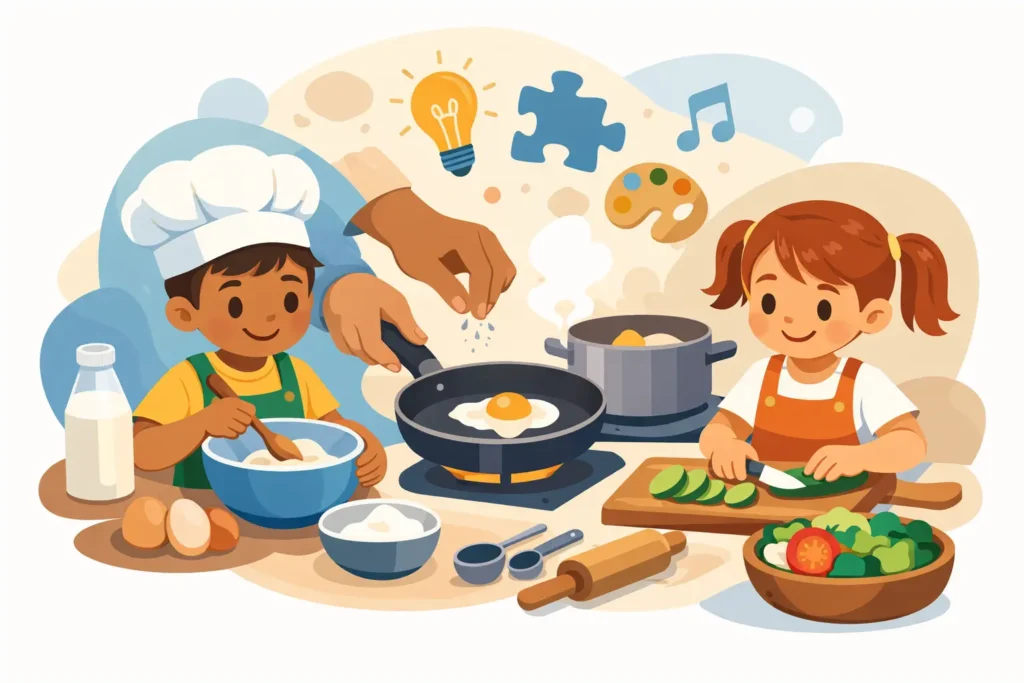
A bowl, a wooden spoon, and a few banana slices can become far more than a snack. Cooking activities for preschoolers learning through play give children a meaningful job to do, a reason to talk, and the joy of seeing their effort turn into something real. For young children, that proud moment of saying, “I made it!” can encourage confidence that reaches well beyond the kitchen.
At Summer Tots, practical projects are part of a nurturing learning experience because children understand ideas more deeply when they can touch, stir, smell, count, and share. Cooking also creates a warm opportunity for families and educators to slow down together while building happy hearts and healthy minds.
Why Cooking Activities Support Preschoolers’ Learning
Preschoolers are naturally curious about how things work. When flour changes texture after water is added, or when bread becomes warm and crisp in a toaster oven, children are observing cause and effect in a way that feels exciting and easy to remember. They are not being asked to sit still and memorize an answer. They are discovering it with their senses.
Cooking supports early math in small, useful ways. A child may count three strawberries, compare a full cup with an empty one, notice that two half-cups make one whole cup, or sort carrot pieces by size. These early experiences build a foundation for number sense without making learning feel like a worksheet.
Language grows at the same time. Words such as mix, pour, smooth, crunchy, sweet, peel, and measure become part of a child’s vocabulary because they have a clear meaning in the moment. Children also practice listening to directions, asking for help, describing what they notice, and taking turns in conversation.
Just as valuable are the social and emotional lessons. A child who waits for a turn to stir is practicing patience. A child who offers a topping to a friend is practicing kindness. When a recipe does not look exactly as expected, a calm adult can show that mistakes are part of learning and that trying again is something to feel good about.
Making the Kitchen Safe and Calm
A preschool cooking activity should feel joyful, not rushed. Before children begin, adults can wash hands together and explain simply why clean hands help keep food safe. Tie back long hair, wipe the work surface, and use child-sized aprons if available. These small routines help children feel responsible and included.
Choose tools that match a child’s abilities. Preschoolers can often use a spoon, whisk, silicone spatula, blunt child-safe knife for soft foods, or a small rolling pin with close adult supervision. Adults should handle hot pans, ovens, boiling water, sharp knives, electric appliances, and any task that could cause a burn or cut. Even familiar foods can be choking risks, so grapes, cherry tomatoes, nuts, hard candy, and similar items need careful preparation or should be avoided according to each child’s age and needs.
It also helps to keep each activity short. One preschooler may happily focus for 15 minutes, while another may be ready to move on after five. The goal is not a perfect recipe. It is an engaging experience where children can participate successfully.
Cooking Activities for Preschoolers’ Learning at Home or School
Make a rainbow fruit salad
Set out a small selection of prepared fruit in different colors, such as strawberries, orange segments, banana slices, kiwi, blueberries, and melon. Invite children to name the colors, count pieces into a bowl, and create patterns if they are interested. They can use a child-safe knife to cut very soft banana or melon pieces, while an adult prepares firmer foods.
As the salad comes together, ask open questions: “Which fruit feels smooth?” “What color should we add next?” “How many blueberries do you have?” This activity supports color recognition, counting, descriptive language, and healthy eating habits. It can also be a gentle way to encourage a hesitant eater to explore a new food without pressure.
Build mini pizzas
Mini pizzas give children a satisfying sense of ownership because every finished pizza looks a little different. Provide English muffins, pita bread, or prepared dough rounds, along with a spoonful of sauce, shredded cheese, and a few simple toppings. Children can spread, sprinkle, and arrange their ingredients before an adult cooks the pizzas.
This is a wonderful activity for following a sequence. First comes the base, then the sauce, then the toppings. Children learn that steps matter, while still having room to make choices. A child who proudly serves a pizza to a sibling, parent, or friend also experiences the generosity that comes from preparing food for someone else.
Shake homemade butter
Pour a small amount of heavy cream into a tightly sealed jar, leaving enough space for shaking. Preschoolers can take turns shaking the jar and watching for the cream to thicken and separate. An adult can open the jar once butter forms, drain the liquid, and help children spread the butter on crackers or bread.
The magic here is in the waiting and observing. Children may expect a quick change, then learn that some results take time and effort. Talk about what they see and hear in the jar as it changes. This simple experiment brings science into the kitchen in a way that feels like a game.
Roll no-bake energy bites
For a quick activity, adults can prepare a safe mixture suited to the group’s dietary needs, such as oats, sunflower seed butter, honey or maple syrup, and finely chopped dried fruit. Children can scoop and roll the mixture into small balls, then coat them in coconut flakes or crushed cereal. Always check carefully for allergies before planning shared food activities.
Rolling builds hand strength and coordination, both helpful for future writing and everyday tasks such as buttoning clothes. Some children may not enjoy sticky textures, and that is okay. They can pour ingredients, count scoops, place finished bites on a tray, or simply watch at first. Participation can look different for every child.
Create vegetable faces
Arrange prepared vegetable slices, hummus or cream cheese, and crackers or toasted bread. Cucumber circles can become eyes, grated carrot can become hair, and a bell pepper strip can make a smile. Children can create their own funny faces, name the emotions they see, and talk about what might make their character feel happy, surprised, or sleepy.
This playful project connects food with creativity and emotional language. It is especially helpful for children who love art but are less eager to try vegetables. Seeing food as something they can arrange and explore may make it feel more familiar over time.
The Adult’s Role Matters More Than the Recipe
Children learn best when adults resist the urge to take over. It can be tempting to fix a messy topping arrangement or pour ingredients more quickly, especially on a busy weekday. Yet a little spill, an uneven scoop, or a crooked pizza face often represents meaningful learning.
Offer one clear instruction at a time and give children enough time to respond. Instead of saying, “Be careful,” try a specific direction such as, “Hold the bowl with one hand while you stir with the other.” Instead of correcting every choice, notice their effort: “You kept trying until the dough came together.” These words help children connect persistence with success.
For working families, cooking does not need to become another large task on the schedule. Let a child wash lettuce for dinner, tear herbs, place napkins on the table, or help pack fruit into a lunch container. Everyday participation is often more sustainable than an elaborate weekend recipe, and it still gives children a valued role in family life.
Learning That Continues Beyond the Kitchen
A thoughtful cooking project can lead naturally into reading, drawing, outdoor observation, and pretend play. Children may draw the ingredients they used, make a simple picture recipe, act out a restaurant scene, or read a story about food and friendship. Educators can extend the experience by inviting children to share what they made and listen to one another’s ideas.
The most meaningful cooking moments are not measured by whether every child eats the finished dish. They are measured in the small signs of growth: a child who tries a new word, waits patiently for a turn, proudly counts ingredients, or smiles as they offer a creation to someone they care about. Give them a safe place, a simple task, and your unhurried attention. They will bring the curiosity.
Pingback: A Kindergarten Teacher Quality Review for Parents – Summer Tots