
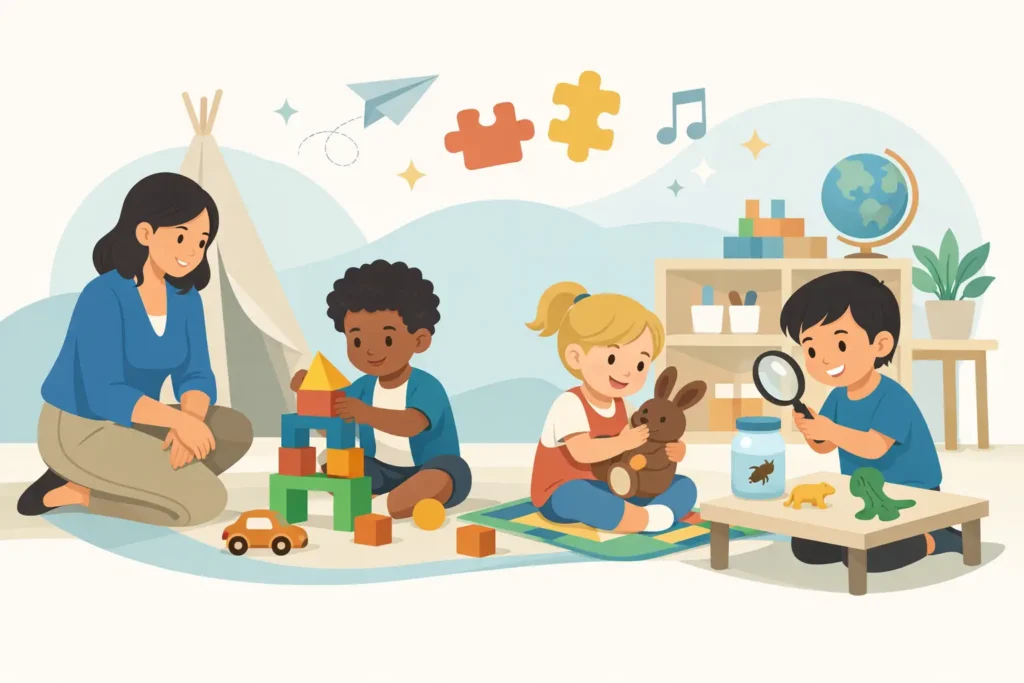
A preschooler carefully placing leaves into a pretend soup is doing far more than making a mess. They may be sharing ideas with a friend, counting ingredients, learning new words, practicing patience, and using their imagination. These everyday moments reveal why play based learning benefits for preschoolers reach far beyond keeping children happily occupied. When play is thoughtfully guided, it gives young children a joyful, meaningful way to understand themselves and the world around them.
For families, especially those balancing busy workdays with their child’s growing needs, play can sometimes look less productive than a worksheet or a page of handwriting. Yet preschoolers learn best by doing, touching, talking, trying, and trying again. Purposeful play gives them a safe place to build the skills that support both school readiness and a happy, healthy childhood.
Play Based Learning Benefits for Preschoolers Start With Curiosity
Young children are natural investigators. They want to know why ice melts, whether a boat will float, how a seed grows, and what happens when colors are mixed together. Play gives that curiosity somewhere to go.
When children make floating boats, observe water vapor, or build geometric forms with everyday materials, they are learning early science and math ideas in a way that feels exciting rather than intimidating. They begin to notice patterns, make predictions, test their ideas, and adjust when something does not work. A boat that sinks is not a failure. It is an invitation to change the design and try again.
This matters because confidence grows through experience. A child who discovers, “I can figure this out,” is developing a mindset that will serve them in reading, problem-solving, friendships, and future classrooms. The goal is not to rush children toward the right answer. It is to help them enjoy asking good questions.
Hands-On Experiences Make Learning Stick
A preschooler may hear that dough changes shape, but rolling, pressing, and cutting it teaches the idea in a much more memorable way. Baking, preparing pizza or sushi, tending a small garden, or caring for chicks can introduce vocabulary, sequencing, measurement, responsibility, and healthy habits at the same time.
These practical projects also help children connect learning to real life. They see that numbers are useful when sharing ingredients, that reading helps them follow a simple recipe, and that careful hands matter when caring for a living thing. Learning becomes something they can use, not simply something they are told to remember.
Language Grows Naturally Through Shared Play
Children do not develop communication skills only by listening to adults. They grow their language when they talk with friends, explain their ideas, negotiate roles, tell stories, and hear caring teachers add new words to the conversation.
In a pretend grocery store, one child may become the cashier while another fills a basket and asks for apples. In a block-building activity, children may discuss which pieces will make a bridge stronger. These exchanges encourage children to listen, take turns, express needs, and speak with increasing clarity.
English-led learning can be especially meaningful when it is woven into warm, familiar activities. Rather than asking children to memorize words in isolation, educators can introduce language as children paint, sing, read stories, explore outdoors, and work on projects together. A child who is encouraged to describe a smooth stone, retell a story, or explain how they built a tower is building both vocabulary and confidence.
Reading development benefits, too. When story time is joyful and interactive, children begin to see books as companions filled with ideas, humor, comfort, and possibility. They learn that print carries meaning, that stories have beginnings and endings, and that their own thoughts deserve to be heard.
Social Skills Are Practiced, Not Just Taught
Preschool is often a child’s first regular community beyond the family. It is where children learn that other people may have different ideas, feelings, and ways of doing things. Play offers daily opportunities to practice these important lessons.
Sharing a favorite toy, waiting for a turn on the slide, deciding who gets to be the doctor in a pretend clinic, or rebuilding a toppled block tower together can be challenging. These moments are also valuable. With patient guidance, children learn to use words instead of grabbing, to notice when a friend is upset, and to find solutions that feel fair.
Character education comes alive in these small interactions. Kindness is not only a word on a wall. It is helping a classmate find a missing puzzle piece. Respect is listening when someone else is speaking. Empathy is offering comfort when a friend falls down.
A nurturing preschool environment does not expect young children to handle every conflict perfectly. They are still learning. What matters is having experienced educators nearby who can name feelings, model calm communication, and help children practice again. Over time, children become more able to manage disappointments and enjoy being part of a group.
Active Play Supports Happy Hearts and Healthy Minds
Preschoolers need movement. Climbing, running, balancing, digging, dancing, and carrying materials help children develop coordination, strength, and body awareness. Outdoor play also gives them space to release energy, breathe fresh air, and experience the changing world around them.
The benefits are emotional as well as physical. A child who has had time to move is often better able to settle into a story, a group activity, or a quiet creative project. Outdoor discoveries can also bring a sense of calm and wonder. Watching an insect, feeling the wind, or collecting fallen leaves can slow a child down in the best way.
This does not mean every minute should be high-energy. Young children need a healthy rhythm of active play, focused exploration, rest, conversation, music, and quiet reading. A well-planned day respects their natural need to move while helping them build the attention they will need for kindergarten.
Play Builds Independence and School Readiness
School readiness is sometimes misunderstood as knowing letters, numbers, and how to complete a worksheet. Those skills have value, but readiness is broader. A child also needs to feel comfortable separating from a parent, following simple routines, asking for help, caring for belongings, and participating in a group.
Play-based settings support these abilities in natural ways. Cleaning up after an art activity teaches responsibility. Choosing materials encourages decision-making. Completing a puzzle builds persistence. Working with classmates develops cooperation. Putting on shoes for outdoor time strengthens independence.
Children also gain early academic foundations through playful experiences. Sorting buttons by color or size introduces classification. Singing rhymes builds sound awareness for later reading. Constructing with blocks develops spatial thinking. Drawing menus in a pretend restaurant encourages early writing.
The best approach is not play or structured learning. Preschoolers benefit from both. Intentional educators create room for open-ended discovery while also offering gentle guidance, routines, story time, early literacy activities, and opportunities to practice new skills. The balance depends on the child, the activity, and the developmental goal.
What Purposeful Play Looks Like
Purposeful play is not leaving children alone with toys and hoping learning happens. It begins with a thoughtfully prepared environment, safe materials, caring relationships, and educators who pay close attention to each child.
An educator may set out cups, scoops, and water for children to explore volume. They may ask, “Which container holds more?” rather than immediately giving an answer. During a dramatic-play activity, they may help a quiet child join in or encourage children to write signs for their pretend shop. Their guidance extends learning while allowing children to remain active participants.
At Summer Tots, this kind of care means creating opportunities for children to explore indoors and outdoors, make meaningful discoveries, and feel seen as individuals. It also means keeping parents informed about the confidence, communication, friendships, and new abilities developing through the day.
How Parents Can Extend Learning at Home
Families do not need expensive toys or elaborate activities to support play-based learning. The most valuable ingredients are time, conversation, and encouragement. Invite your child to help wash vegetables, sort socks, build a blanket fort, draw a map, or tell you about a favorite story.
Try to leave room for your child’s ideas. If they turn a cardboard box into a spaceship, ask where it is going and what supplies are needed. If they are frustrated by a tricky task, offer reassurance before stepping in. “What else could we try?” can be more helpful than taking over.
It is also helpful to remember that play does not always look calm or polished. Children may repeat the same game, create clutter, disagree with siblings, or abandon a project halfway through. These moments are part of learning. With reasonable boundaries, patient support, and time to explore, children gradually become more capable and confident.
A childhood filled with purposeful play gives preschoolers more than early academic skills. It gives them the reassuring feeling that their ideas matter, their questions are welcome, and they are capable of learning one joyful step at a time.
Pingback: How to Manage Preschool Separation Anxiety – Summer Tots
Pingback: 12 Questions to Ask When Choosing Preschool – Summer Tots
Pingback: How to Encourage Preschool Curiosity Every Day – Summer Tots
Pingback: English Immersion Versus Bilingual Preschool – Summer Tots
Pingback: Play School Versus Academic Preschool for Your Child – Summer Tots
Pingback: What Phonics Classes Build Before First Grade – Summer Tots
Pingback: A Parent’s Guide to Kindergarten Open Houses – Summer Tots
Pingback: Can Daycare Support School Readiness? Yes, It Can – Summer Tots