
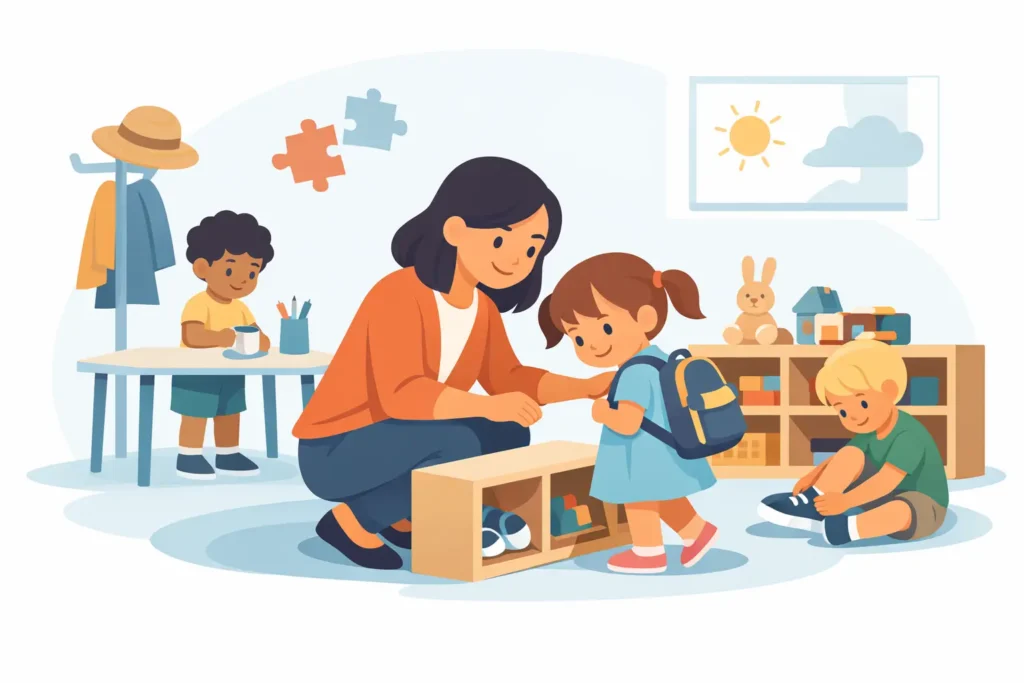
A preschooler who insists, “I can do it myself,” is not being difficult. They are practicing one of the most valuable skills of early childhood: believing in their own ability to try. Learning how to build preschool independence does not mean expecting a young child to manage everything alone. It means giving them safe, age-appropriate chances to make choices, solve small problems, and feel proud of their growing capabilities.
For busy families, helping children become more independent can make daily routines smoother. More importantly, it helps children arrive at school feeling secure, curious, and ready to participate. A child who can put away a bag, ask for help politely, or try a task before giving up is building confidence that reaches far beyond preschool.
Independence Begins With Connection
Children are most willing to try new things when they feel safe and supported. Independence grows from connection, not from pressure. A child who knows an adult is nearby, calm, and ready to help is more likely to attempt buttoning a shirt, opening a lunch container, or joining a group activity.
This is why it helps to stay close without taking over. Instead of quickly finishing a task for your child, pause and offer simple encouragement: “You are working hard on that zipper. Would you like to try one more time?” If they become frustrated, you can guide one small step and let them complete the next.
There is a balance to find. Stepping in too quickly can send the message that a task is too hard. Waiting too long when a child is overwhelmed can turn practice into tears. The goal is not perfection. The goal is helping your child learn, “I can try, and someone will support me when I need it.”
How to Build Preschool Independence Through Daily Routines
The most meaningful practice often happens in ordinary moments. Children do not need a complicated program to learn responsibility. They need repetition, clear expectations, and enough time to participate.
Morning is a wonderful place to start. A preschooler may be able to choose between two weather-appropriate outfits, place pajamas in a basket, carry their backpack, or help pack a water bottle. At first, these jobs may take longer than doing them yourself. That extra time is an investment in confidence.
After school, create a predictable arrival routine. Your child can put shoes in the same spot, hang up a bag, place a lunchbox on the counter, and wash hands. When each item has a clear home, children can succeed without needing constant reminders. A low hook, reachable shelf, or labeled basket can make a big difference.
Mealtimes also offer practical learning. Invite your child to carry napkins, pour water from a small pitcher, spread a soft topping, or help clear dishes. These moments build coordination and responsibility while showing children that they are valued members of the family.
Bedtime brings another gentle opportunity. Your child may put toys away, choose a book, place dirty clothes in a hamper, and help prepare clothes for the next day. Keep expectations realistic. Some evenings will be too tired or rushed for practice, and that is okay. Consistency over time matters more than completing every task perfectly.
Give Choices That Feel Manageable
Preschool children need choices, but too many options can feel overwhelming. A simple choice lets them experience control while keeping the day moving forward. “Would you like the red cup or the blue cup?” works better than asking them to choose from every cup in the cabinet.
Offer choices that you can genuinely accept. If it is time to leave, try, “Would you like to walk to the car like a dinosaur or hop like a bunny?” Your child has some control over how the transition happens, while the boundary remains clear.
Choices can also support emotional growth. When a child is upset, you might ask, “Would you like a hug, or would you like to sit quietly beside me?” This teaches children to notice what they need and communicate it with words.
Let Children Help With Real Work
Children are often more capable than adults expect, especially when tasks have a real purpose. Pretend play is valuable, but practical work can be just as joyful. Watering plants, sorting socks, wiping a small table, feeding a pet with supervision, and mixing ingredients for a snack all help children see themselves as capable contributors.
At school, hands-on activities create similar opportunities. When children help prepare pizza or sushi, create geometric forms, observe water vapor, or make floating boats, they are not only learning facts. They are making decisions, using their hands carefully, sharing materials, and staying with a task from beginning to end.
Some tasks will be messy. A child may spill water while pouring, use too much glue, or fold laundry in a very unusual way. These moments are part of learning. Keep safety limits firm, then focus on the effort: “You cleaned up the spill. That was responsible.”
Teach Problem-Solving Before Giving Answers
Independence includes learning what to do when something does not go as planned. Rather than immediately solving every small problem, give your child a chance to think.
If a toy will not fit into its box, ask, “What could we try?” If they cannot reach something, ask, “What would help you get it safely?” If two children want the same item, help your child practice words such as, “Can I have a turn when you are finished?”
Young children often need a little coaching before they can solve a problem independently. You might name two possible solutions and let them choose. Over time, they begin to use those ideas on their own. This is how confidence grows: not because life is always easy, but because a child learns that challenges can be approached calmly.
Build Self-Care Skills With Patience
Dressing, toileting, handwashing, eating, and tidying up are major preschool achievements. Each skill is made of many small steps, and children develop at different speeds. One child may happily put on shoes but need help with socks. Another may manage a spoon well but struggle to open a lunch container.
Break tasks into manageable parts. For example, you can start a zipper and let your child pull it up, or lay out clothes in the order they should be worn. As their confidence grows, gradually offer less help. This approach supports success without making a child feel rushed.
Practicing at calm times is especially helpful. Learning to fasten a button is much harder when everyone is hurrying out the door. Set aside a few relaxed minutes during the weekend or after a nap, when your child can practice without pressure.
Independence Also Means Knowing When to Ask for Help
A truly independent child is not one who never needs an adult. It is a child who can recognize when help is needed and ask for it safely. Teach simple phrases such as, “Can you help me, please?” “I do not understand,” and “I need a teacher.”
This is particularly important in a preschool setting. Children need to know that they can tell a trusted adult if they are hurt, worried, thirsty, or having difficulty with a friend. At Summer Tots, caring educators can encourage children to try for themselves while remaining a steady source of comfort and guidance.
When your child asks for help at home, respond warmly even if you encourage another attempt. You might say, “I am glad you asked. Let us look at it together.” This keeps help-seeking connected to confidence rather than shame.
Notice Effort, Not Just Results
Praise is most helpful when it is specific and sincere. Rather than saying “Good job” for everything, describe what you saw: “You kept trying until the puzzle piece fit,” or “You remembered to put your shoes away without being asked.” Children begin to understand which actions they can repeat.
It also helps to avoid comparing children. Independence does not look exactly the same at every age or in every child. Temperament, language development, physical coordination, and previous experience all matter. A quiet child may show confidence by trying a new activity beside a teacher, while another child may eagerly volunteer to lead the line.
Celebrate both kinds of progress. The small moments count: a child washing hands independently, carrying a plate carefully, using kind words with a friend, or recovering after a mistake. These are the everyday building blocks of happy hearts, healthy minds, and growing confidence.
As your child learns to do more, let their pride have room to shine. A little extra time, a little patience, and a loving reminder that “you can try” can help them carry that confidence into every new classroom, friendship, and adventure ahead.
Pingback: What Is Preschool Age? A Parent’s Gentle Guide – Summer Tots
Pingback: How Preschoolers Develop Self Regulation – Summer Tots