
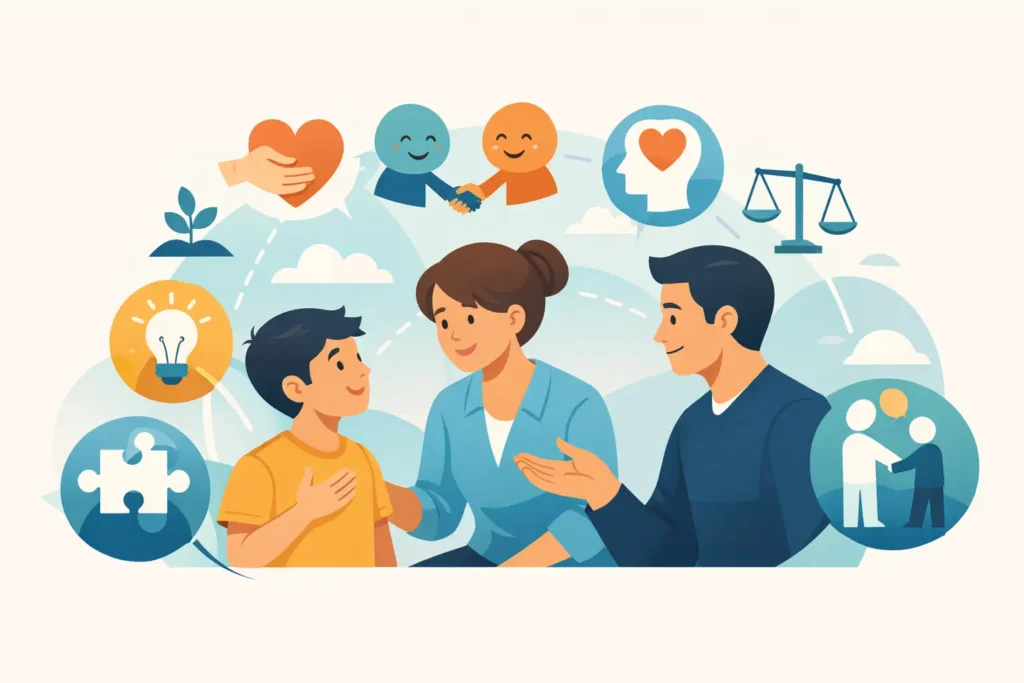
A child who says, “I’m mad because I wanted the red truck,” has taken a meaningful step forward. So has the child who waits briefly for a turn, notices a friend is sad, or proudly helps clean up after an activity. These everyday social emotional development examples show how children gradually learn to understand themselves, relate to others, and feel secure in a group.
For preschoolers and kindergarteners, these skills do not grow from lectures. They grow through warm relationships, repeated practice, playful routines, and caring adults who help children find words for big feelings. At home and at school, small moments can shape happy hearts and healthy minds.
What Social Emotional Development Looks Like in Young Children
Social emotional development is a child’s growing ability to recognize feelings, manage behavior, build friendships, show care for others, and make thoughtful choices. It is closely connected to learning. A child who feels safe is more ready to listen to a story, try a new activity, ask for help, and keep going when something feels difficult.
Development is not a straight line. A child may confidently greet friends one morning and cling tightly to a parent the next. Another may use kind words at school but struggle with frustration at home after a long day. These changes are normal. Young children are still learning how to handle feelings that can seem much bigger than their vocabulary.
The goal is not perfect behavior. The goal is progress: helping children become more confident, considerate, and able to recover after a difficult moment.
12 Social Emotional Development Examples for Preschoolers
1. Naming a feeling
When a child says, “I’m disappointed,” instead of crying or throwing a toy, they are building emotional awareness. At first, children may only know happy, sad, mad, and scared. Adults can gently expand those words: frustrated, worried, excited, proud, lonely, or disappointed.
During a practical activity, a teacher might say, “Your boat sank after you worked hard on it. You look disappointed. Let’s think about what we can change.” The child learns that feelings are welcome and manageable.
2. Asking for help with words
A preschooler who says, “Can you help me open this?” is practicing more than language. They are learning to notice when they need support and trust an adult enough to ask for it.
This can be encouraged during dressing, snack time, art, and hands-on projects. Instead of immediately stepping in, adults can pause and offer a simple prompt: “Would you like to try again, or would you like help?” That small choice supports both independence and confidence.
3. Waiting for a turn
Waiting is hard when you are four years old and the swing, paintbrush, or favorite book is right in front of you. Yet turn-taking is an early lesson in fairness and self-control.
Children learn best when waiting has a clear ending. A teacher may say, “First Aisha has a turn, then it is your turn.” Sand timers, songs, and predictable routines can make the wait feel less overwhelming. Young children do not need to wait perfectly every time. They need patient opportunities to practice.
4. Joining play respectfully
Walking up to a group of children can feel surprisingly brave. A child who asks, “Can I play too?” or offers a related idea is learning how friendships begin.
Adults can model simple phrases before outdoor play or learning centers: “What are you building?” “Can I be the customer?” “Would you like to make a road together?” Some children need more time to observe before joining. That is okay. Gentle support is more helpful than forcing a child into a group before they feel ready.
5. Showing empathy when someone is hurt
Empathy begins with noticing. A child may see a friend fall down, bring over a tissue, or ask, “Are you okay?” These are tender signs that they are beginning to understand another person’s experience.
Adults can make the connection clear: “Ben is crying because he bumped his knee. What could help him feel better?” The answer might be getting a teacher, giving space, or offering a kind drawing. Empathy should never mean asking a child to take responsibility for another child’s feelings. It means helping them respond with care.
6. Using a calm-down strategy
Taking deep breaths, squeezing play dough, sitting in a quiet cozy area, or asking for a hug are all useful strategies when emotions rise. A child who learns to pause before hitting or shouting is developing self-regulation.
Calm-down skills work best when taught during peaceful moments, not only in the middle of a meltdown. Children can practice breathing like they are smelling a flower and blowing a bubble, or slowly count while washing their hands. What helps one child may not help another, so adults can offer a few comforting options.
7. Repairing a mistake
Children will grab, interrupt, knock over a tower, and sometimes say unkind things. These moments are part of learning. What matters is what happens next.
A meaningful apology is more than repeating “sorry.” A child might help rebuild the tower, return a toy, bring a friend an ice pack, or practice a kinder phrase. Adults can calmly say, “You were upset, and you pushed. Pushing hurt your friend. Let’s help make it better.” This approach teaches responsibility without shame.
8. Persisting through a challenge
Trying again after a puzzle piece will not fit or a drawing does not look as expected builds resilience. Children need to hear that struggle is not failure.
Hands-on learning is especially helpful here. While baking, building geometric forms, or creating a floating boat, children can test ideas, make changes, and celebrate effort. Instead of saying only, “Good job,” try, “You kept working even when it was tricky.” Specific encouragement helps children recognize their own growing strength.
9. Following a group routine
Putting a backpack away, joining circle time, washing hands before meals, and cleaning up after play all support a child’s sense of belonging. Routines tell children, “This is a safe place, and you know what to do here.”
Children may need visual reminders, songs, or extra time to settle in. Consistency matters more than strictness. A caring adult can hold the boundary while still recognizing the child’s feelings: “You want to keep playing. It is hard to stop. Now it is cleanup time, and I will help you begin.”
10. Celebrating someone else’s success
When a friend reads a new word, finishes a puzzle, or receives a turn with a favorite material, children may feel happy, jealous, or both. Learning to clap, say “You did it,” or notice another person’s effort supports kindness and friendship.
This is also a chance to avoid comparisons. Rather than praising one child as the best, adults can celebrate different strengths: “You worked carefully on your letters,” or “You shared your idea with the group.” Every child deserves room to grow at their own pace.
11. Making a simple choice
Choosing between two books, deciding which color to use, or selecting a role during pretend play helps children develop independence. Small choices also reduce power struggles because children feel seen and included.
Choices should be real and manageable. “Would you like to wear the blue shirt or the green shirt?” is easier for a young child than an open-ended question with too many possibilities. Clear boundaries remain important: a child may choose which fruit to eat, but not whether to wear a seat belt.
12. Speaking up respectfully
A child who says, “I don’t like that,” “Please stop,” or “I was using that” is learning to protect their own needs with words. This is an essential social emotional skill, not disrespect.
Adults can help children practice a firm but kind voice. They can also show children that speaking up is heard: “Thank you for telling me. I will help you solve this.” When children know adults will listen, they are less likely to rely on tears, grabbing, or silence.
How Parents and Teachers Can Support These Skills Together
Children benefit most when the caring adults in their lives use similar messages. A teacher may help a child say, “I need space,” while a parent uses the same phrase at home after a busy day. This consistency makes new skills easier to remember when emotions are high.
Talk about feelings in ordinary moments, not only when there is a problem. While reading, ask how a character might feel. While preparing dinner, mention your own experience in a calm, age-appropriate way: “I felt frustrated when the recipe did not work, so I took a breath and tried again.” Children learn by watching how adults handle disappointment, joy, and conflict.
Play is another powerful teacher. Pretend kitchens, building areas, garden projects, water play, and cooperative games naturally invite children to negotiate, share ideas, solve problems, and care for living things. At Summer Tots, purposeful play and practical exploration give children many gentle chances to practice these skills with trusted educators nearby.
It also helps to notice progress that may look small from the outside. Perhaps your child used words before crying, sat beside a new classmate, or recovered from a hard goodbye a little faster. These moments are signs of growth worth recognizing.
A child does not need to be the loudest in the room to be socially confident. With time, patience, and loving guidance, each child can learn that their feelings matter, other people’s feelings matter too, and there is always a kind next step to try.
Pingback: Extended Day Care for Working Parents That Cares – Summer Tots