
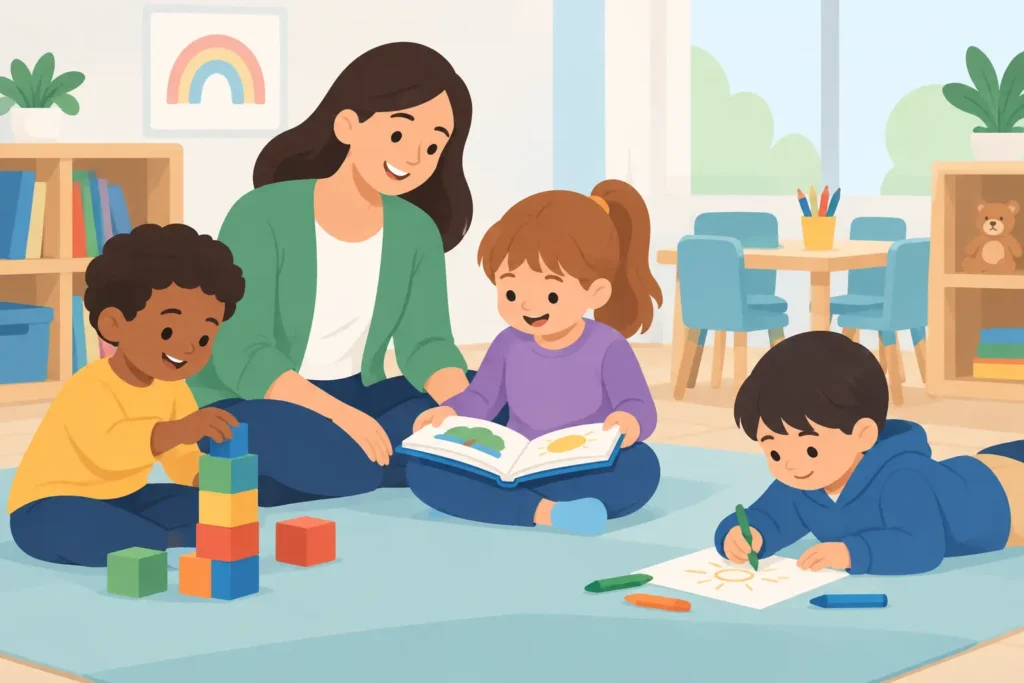
The first school morning can feel big for a young child: a new classroom, new adults, a bag to carry, and a parent saying goodbye at the door. Parents often wonder, can daycare support school readiness in a meaningful way, or is it simply a safe place to spend the day? The right early learning setting can do far more than fill the hours. It can help a child arrive at school with happy hearts, healthy minds, and the confidence to join in.
School readiness is not about expecting preschoolers to sit still for long periods or memorize worksheets. It is about helping them build the everyday skills that make learning feel possible: listening, speaking up, trying again, caring for their belongings, making friends, and feeling secure away from home. A nurturing daycare program gives children many small chances to practice these skills before the first day of formal school.
How Daycare Can Support School Readiness
A child is more ready for school when familiar routines no longer feel like a challenge. At a thoughtful daycare, children learn that the day has a gentle rhythm. They greet their teachers, put away their bags, join circle time, wash their hands, eat with friends, tidy up, play outside, and transition to a new activity.
These moments may seem simple, but they give children a sense of order and independence. A child who has practiced following a routine is more likely to feel calm when a kindergarten teacher says, “It is time to put our materials away,” or “Let’s line up for outdoor play.” They know what it feels like to be part of a group while still being seen as an individual.
Consistency matters, especially for young children. Yet a routine should never become rigid. Children need patient support when they are tired, worried, or still learning how to separate from a parent. School readiness grows best when expectations are clear and adults respond with warmth.
Confidence begins with being known
Children are more willing to participate when they trust the adults around them. An experienced educator notices the child who hangs back during a group game, the one who is ready for a bigger challenge, and the one who needs extra encouragement to use words instead of tears.
That individual attention is not a small extra. It helps children develop the belief that they can manage new situations. When a teacher says, “You kept trying until the puzzle piece fit,” a child learns persistence. When they are invited to share an idea during story time, they learn that their voice matters.
For working parents, a dependable daycare can also bring an important sense of continuity. Children benefit when the caring messages they hear at home are reinforced during the day: be kind, ask for help, take turns, and keep trying. This partnership helps children feel secure in both places.
Play Builds the Skills Behind Classroom Learning
Play-based learning is sometimes mistaken for free time without purpose. In reality, well-planned play gives children a natural way to practice the skills school asks of them every day.
When children build a tower together, they are learning to plan, negotiate, count, balance, and recover when it falls down. When they make a floating boat or observe water vapor, they are asking questions and testing ideas. When they bake, prepare pizza, or make sushi, they are following steps, measuring, using their hands carefully, and feeling proud of a finished project.
These experiences make learning real. A child does not only hear that shapes have names – they create geometric forms. They do not only hear that living things grow – they may observe chicks with care and curiosity. Such hands-on activities encourage children to notice, wonder, explain, and try again. Those are strong foundations for future reading, math, science, and problem-solving.
Outdoor play has an equally important place in readiness. Running, climbing, balancing, digging, and playing games build coordination and body awareness. They also give children space to practice sharing equipment, waiting for a turn, and managing big feelings when a game does not go their way. A child who has regular active play is not being distracted from learning. They are developing the physical confidence and self-control that help them participate in it.
Literacy Grows Through Conversation and Stories
School readiness includes early literacy, but it does not begin with pressure to read before a child is ready. It begins with joyful language experiences: songs, rhymes, conversations, picture books, storytelling, and the delight of recognizing a familiar letter in their name.
In an English-led learning environment, children can hear and use English throughout meaningful parts of the day. They may describe a project, answer a teacher’s question, sing a song, retell a story, or ask a friend to join a game. This regular exposure helps language become something they use with confidence, not simply something they repeat.
Reading aloud is especially valuable because it develops attention, vocabulary, imagination, and listening skills at once. A caring teacher pauses to ask, “What do you think will happen next?” or “How do you think the character feels?” Children learn that books are not tests. They are invitations to think, speak, laugh, and connect.
Children develop at different speeds. Some may quickly enjoy sounding out words, while others first need more time with stories and conversation. A strong program respects this difference. The goal is not to compare children, but to help each one make steady, encouraging progress.
Social and Emotional Readiness Cannot Be Left to Chance
A child may know letters and numbers yet still find school difficult if they do not know how to join a group, handle disappointment, or ask for help. Social and emotional growth is one of the clearest ways daycare can prepare children for the next stage.
Daily life with peers offers real practice. Children learn to say, “Can I have a turn when you are done?” They learn that a friend may want a different role in pretend play. They learn that mistakes happen, feelings can be named, and adults can help them find a kinder response.
Character education gives these moments direction. Kindness, empathy, respect, responsibility, and gratitude are not abstract lessons when they are woven into daily interactions. Children see what it means to care for classroom materials, comfort a friend, thank a helper, or include someone in a game.
There will still be hard days. A caring daycare does not promise that every child will always be cheerful or conflict-free. Instead, it gives children safe guidance through ordinary challenges. Over time, they gain the emotional tools to recover, communicate, and keep participating.
What Parents Should Look for in a Readiness-Focused Daycare
Not every daycare supports readiness in the same way. A program with a busy schedule may offer convenience, but the quality of interactions matters more than a long list of activities. Parents should look for a place where educators speak kindly with children, know their personalities, and can explain what children are learning through play.
The environment matters too. Classrooms should feel welcoming, organized, and designed for young learners to explore safely. Outdoor spaces should invite movement and discovery. Materials should encourage children to create, build, read, imagine, and solve problems rather than simply wait for instructions.
It is also helpful to ask how the program communicates with families. Parents deserve more than a quick report that their child ate and slept. Meaningful communication can share progress in confidence, friendships, language, attention, literacy, and independence, along with gentle guidance when a child needs support.
At Summer Tots, this kind of holistic care brings together purposeful classroom learning, interactive play, outdoor activity, practical projects, reading development, and character guidance. The aim is not to rush childhood. It is to help each child feel capable, cared for, and excited about what they can do next.
Readiness Looks Different for Every Child
There is no single checklist that can fully capture whether a child is ready for school. One child may confidently speak to adults but need help waiting patiently. Another may love books yet feel shy in a group. Both can be growing beautifully.
The most helpful question is not, “Is my child ahead?” It is, “Is my child becoming more confident, curious, independent, and able to connect with others?” When daycare offers patient guidance, meaningful play, and a secure relationship with caring educators, it can be a powerful part of that growth.
Give your child time to practice, time to be heard, and time to enjoy learning. Those everyday experiences can help the next classroom feel less like a leap into the unknown and more like a welcoming new place to grow.