
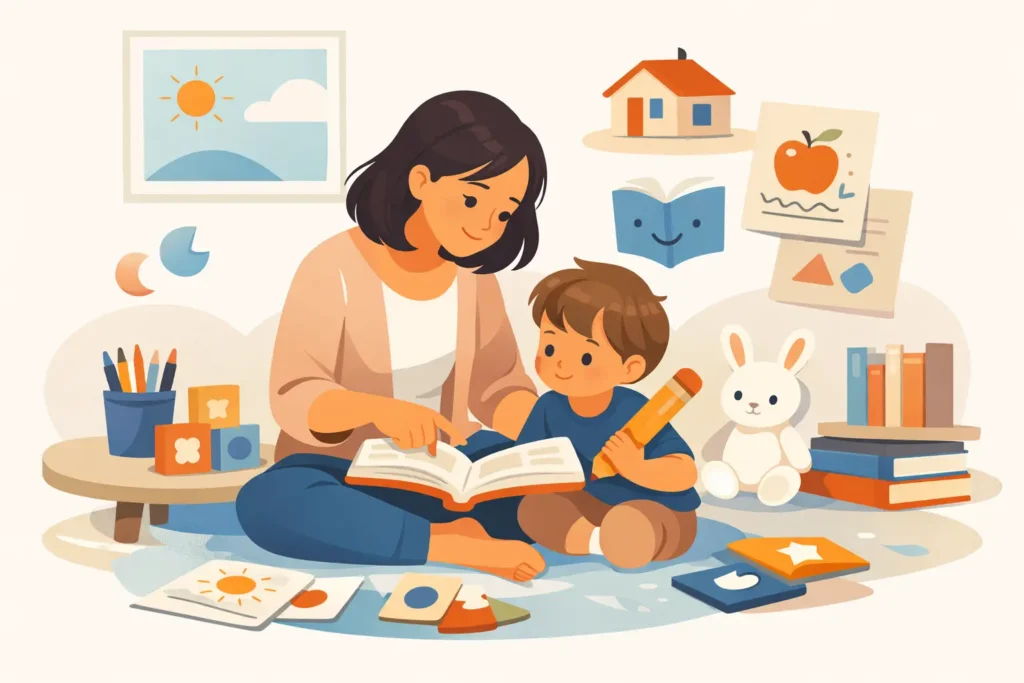
A preschooler who proudly points to the first letter of their name, retells a favorite story, or notices a sign on the way home is already building the foundation for reading. Early literacy activities for preschoolers do not need to look like formal lessons. The most meaningful moments often happen while sharing a book before bed, singing during cleanup, making pizza together, or talking about what is growing in the garden.
For young children, literacy begins with connection. They learn that words carry meaning, that their ideas deserve to be heard, and that books can be joyful companions. With patient guidance and plenty of play, children can grow into confident communicators long before they read a full page on their own.
What early literacy looks like before reading
Early literacy is much more than memorizing the alphabet or practicing handwriting. It includes listening carefully, speaking in sentences, learning new words, noticing sounds in language, handling books with care, and understanding that print tells a story.
A child who says, “The caterpillar is hungry,” after hearing a story is practicing comprehension. A child who claps the parts of their name is hearing the rhythm of words. A child who draws a family picture and explains it is learning that pictures, marks, and words can share a message.
Letters and sounds matter, but they are most useful when they are connected to something real. Preschoolers are more likely to remember the letter M when it belongs to Mommy, mango, or the moon they saw outside. This is why playful, familiar experiences are often more effective than long drills or stacks of worksheets.
Early literacy activities for preschoolers that feel like play
The goal is not to fill every moment with instruction. Children need time to move, imagine, rest, and explore. A few warm, repeated literacy moments each day can have a greater impact than an activity that feels pressured or too difficult.
Make story time a conversation
Reading aloud is one of the simplest and most powerful ways to support literacy. Choose books with clear pictures, engaging characters, rhyme, repetition, or topics your child already loves, such as animals, trucks, cooking, or friendship.
Pause occasionally instead of reading every page straight through. Ask, “What do you think will happen next?” or “How do you think she feels?” Let your child point, answer in a few words, or tell a completely different version of the story. There is no need to correct every response. The conversation is where language, confidence, and imagination grow.
Reading the same book again and again is also valuable. Repetition helps children recognize patterns, remember new vocabulary, and begin to join in with familiar phrases. That joyful “I know this part!” is a sign of growing literacy.
Turn daily routines into word-rich moments
Children learn language best when words are attached to real experiences. During breakfast, name the foods, describe their colors and textures, and invite your child to make choices: “Would you like the crunchy apple or the soft banana?” While getting dressed, talk about buttons, pockets, stripes, and socks.
At the grocery store, notice the first letter on a cereal box or help your child find the word “milk” on a shopping list. While driving, point out a stop sign and talk about what it means. These small conversations show children that print is useful in everyday life.
Try expanding what your child says rather than simply correcting it. If they say, “Dog run,” you might respond, “Yes, the big brown dog is running very fast.” This gives them a richer model of language while keeping the exchange positive and natural.
Sing, rhyme, and play with sounds
Before children can connect letters with sounds, they need to hear the sounds inside words. Songs, nursery rhymes, clapping games, and silly word play make this skill feel easy and fun.
You might ask, “What rhymes with cat: hat or sun?” Or play a listening game: “I spy something that starts with sss.” Keep the focus on the sound, not the letter name at first. Children can also clap syllables in family names, favorite foods, or animals: wa-ter-mel-on, el-e-phant, Su-san.
Some children enjoy these games immediately; others need more time. If your child loses interest, move on. A relaxed atmosphere protects their curiosity and helps them see language as something enjoyable, not something they can get wrong.
Invite children to write in their own way
Preschool writing begins with scribbles, lines, shapes, and drawings. These early marks are meaningful. When children pretend to write a menu in their play kitchen or create a card for a grandparent, they are discovering that writing communicates an idea.
Keep crayons, washable markers, paper, and simple notebooks within reach. Invite your child to draw what they saw at the park, make a sign for a block tower, or add their name to a picture. If they ask you to spell a word, say the sounds slowly and celebrate their effort rather than taking over.
Name writing is a lovely place to begin, but it should not become a daily test. Some children are ready to copy letters; others are still developing the hand strength and control needed to hold a pencil comfortably. Play dough, painting, building, cutting with child-safe scissors, and outdoor climbing all support the muscles children will later use for writing.
Build literacy through hands-on projects
A practical project creates a reason to talk, listen, read, and record ideas. While baking muffins, children can help notice numbers, follow simple steps, describe smells, and retell what happened first, next, and last. When making a floating boat, they can predict whether it will stay on top of the water and draw the results afterward.
Nature offers equally rich opportunities. Observe a chick, a leaf, or a cloud and ask your child what they notice. Introduce helpful words such as fluffy, smooth, melt, float, or shadow. New vocabulary becomes easier to remember when children can see, touch, and experience what it describes.
At Summer Tots, purposeful projects, outdoor discovery, and shared stories are part of creating happy hearts and healthy minds. The same spirit can continue at home: follow your child’s questions and allow room for wonder.
Create a calm, inviting book space
Children are more likely to reach for books when books are easy to see and easy to hold. A small basket of age-appropriate books near a cozy cushion can be enough. Rotate a few titles every couple of weeks, while keeping beloved favorites available.
Let your child choose some of the books, even if their choice is a wordless picture book or the same animal story every night. Wordless books are especially helpful because they invite children to create language, describe details, and tell a story in their own words.
Your own habits matter, too. When children see adults reading recipes, notes, magazines, or books for enjoyment and information, they learn that reading belongs in family life.
How to keep literacy joyful and pressure-free
Every child develops at a different pace. One preschooler may recognize many letters but be quiet during story time. Another may tell detailed stories but show little interest in writing. Both are learning, and both benefit from gentle encouragement.
Watch for signs that an activity is becoming frustrating. If your child avoids it, becomes upset, or says they cannot do it, simplify the task. Read a shorter book, offer two choices instead of many, or return to a favorite song. Confidence is not built by pushing children past their limits. It grows when they feel safe enough to try again.
It also helps to protect unstructured play. Pretending to run a restaurant, building a fort, caring for dolls, or creating a jungle from blocks all require children to negotiate, describe, imagine, and solve problems. These are literacy-rich experiences, even when no alphabet cards are involved.
If your family uses more than one language, continue speaking, singing, and telling stories in the language that feels most natural at home. A strong foundation in any family language supports communication and helps children learn additional languages with confidence. Consistent English exposure can be helpful, but warm conversation matters more than perfect pronunciation.
The loveliest literacy routine is one your child associates with belonging: a book tucked into bedtime, a silly rhyme while washing hands, or a drawing shared proudly at the end of the day. In those ordinary moments, children learn that their voice matters – and that reading and writing will help them share it with the world.
Pingback: How to Improve Preschool Communication Every Day – Summer Tots