
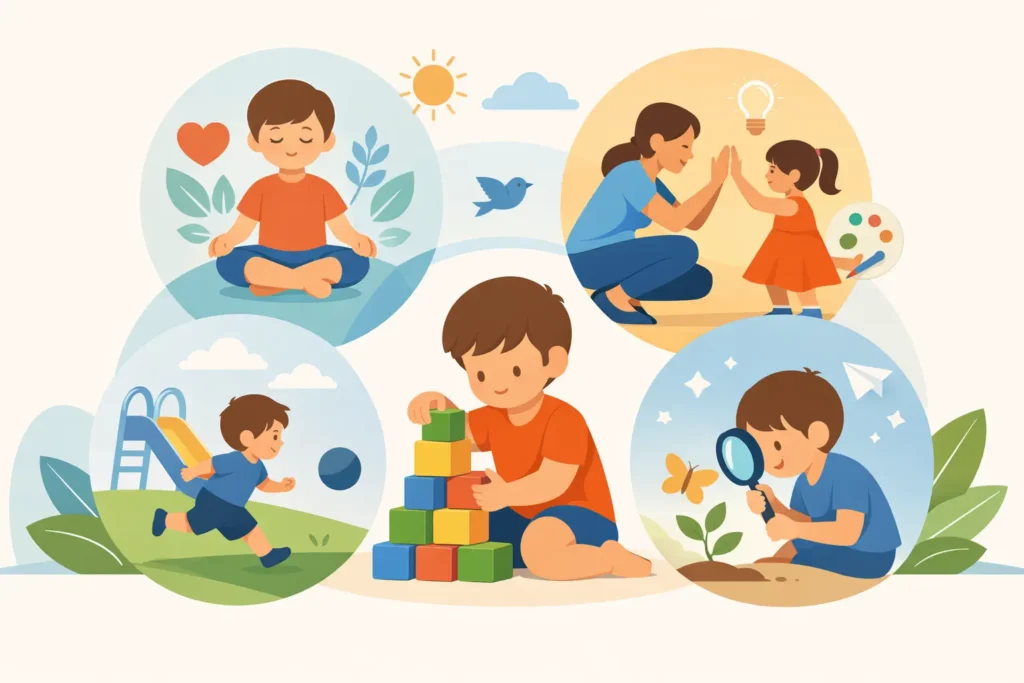
A child who proudly pours water into a cup, comforts a friend who is sad, asks why a boat floats, and tries again after a block tower falls is learning far more than one lesson at a time. These small, meaningful moments show what is holistic development in early childhood: supporting the whole child, not just one skill or school subject.
For young children, learning does not happen in neat, separate boxes. Their language grows while they play with friends. Their confidence builds when they complete a practical task. Their physical coordination develops as they climb, run, draw, pour, and create. A nurturing early learning environment recognizes these connections and helps children grow with happy hearts and healthy minds.
What Is Holistic Development in Early Childhood?
Holistic development in early childhood is an approach that cares for a child’s intellectual, emotional, social, physical, creative, and moral growth together. It recognizes that children learn best when they feel safe, known, capable, and encouraged to explore.
Academic readiness still matters. Children benefit from developing early literacy, number awareness, listening skills, and the ability to follow instructions. But readiness for school is bigger than knowing letters or completing worksheets. A child also needs to communicate needs, manage feelings, take turns, solve simple problems, care for belongings, and keep trying when something feels difficult.
This is why a holistic program blends purposeful teaching with play, movement, conversation, stories, outdoor experiences, practical projects, and caring guidance. Rather than rushing children toward one narrow definition of achievement, it gives them a strong foundation for learning and life.
The Areas of Growth That Work Together
Every child develops at a different pace, and one area of growth can affect another. A child who is still learning to express frustration, for example, may find it harder to join group activities. A child who feels secure with a trusted teacher may be more willing to speak English, attempt a new puzzle, or make a new friend.
Thinking and early learning
Cognitive development includes curiosity, memory, attention, reasoning, and the early building blocks of reading, writing, math, and science. It grows when children are invited to ask questions and test ideas, not simply memorize answers.
A practical activity can make learning memorable. When children make floating boats, they notice what stays above water and what sinks. When they observe water vapor, they begin to see change happening before their eyes. When they create geometric forms or measure ingredients for pizza, abstract concepts become something they can touch, discuss, and understand.
Communication and literacy
Language grows through warm, frequent conversation. Reading aloud, singing, storytelling, describing an activity, and talking through a disagreement all help children build vocabulary and confidence.
English-led instruction can give children valuable exposure, especially when it is delivered gently and naturally through daily routines and play. The goal is not to pressure a child to perform. It is to help them enjoy words, understand what they hear, share their ideas, and develop the listening skills that support future learning.
Emotional strength and self-awareness
Young children have big feelings and are still learning what to do with them. Holistic development gives emotions a place in the day. Educators can name feelings, offer comfort, set calm boundaries, and help children find words or safe strategies when they are upset.
This does not mean children will never cry, argue, or feel frustrated. Those experiences are part of growing up. What matters is that they are supported through them. Over time, a child learns, “I can feel disappointed and still try again,” or “I can ask for help instead of grabbing.” That growing self-awareness is a powerful form of confidence.
Social skills and character
Friendships are a daily classroom for kindness, patience, empathy, and cooperation. Children learn these skills while waiting for a turn, inviting someone into a game, working on a shared project, and repairing a mistake after a conflict.
Character education is most meaningful when it is practiced, not just talked about. A child who helps feed chicks, shares materials while making sushi, or works with classmates to tidy an activity area begins to understand responsibility and care. These habits support a respectful classroom and carry into family life, too.
Physical health and coordination
Active bodies support active minds. Outdoor play gives children room to run, balance, climb, notice nature, and release energy. Fine-motor activities such as painting, cutting, building, baking, and shaping dough strengthen the hands children will later use for writing and everyday tasks.
Physical development is not about making every child an athlete. Some children love energetic group games, while others feel more comfortable gardening, carrying materials, or practicing a new movement at their own pace. A thoughtful program offers variety, supervision, and encouragement so every child can participate safely.
Creativity and independence
Creativity is not limited to art time. It appears when a child imagines a new use for a cardboard box, invents a story, chooses colors for a project, or finds another way to build a bridge with blocks. Open-ended experiences let children make choices and see that their ideas have value.
Independence grows in similarly ordinary moments: putting away a bag, washing hands, helping prepare food, choosing a book, or finishing a task before moving on. These responsibilities may seem small to adults, but they tell children, “You are trusted. You can do meaningful things.”
What Holistic Learning Looks Like in a Typical Day
A holistic day has a rhythm that makes children feel secure while leaving room for discovery. It may include a welcoming arrival, group conversation, guided learning, free play, reading, meals, rest, outdoor movement, and hands-on projects. Each part of the day can support more than one kind of development.
Consider a simple baking activity. Children practice listening and following a sequence. They use fine-motor control to stir or sprinkle. They notice quantities and changes in texture. They wait, cooperate, and take pride in contributing. Later, they may describe the experience to a parent, strengthening language and memory.
The same is true of caring for living things. Raising chicks can encourage observation and scientific thinking, while also teaching gentleness and responsibility. It can spark questions that adults do not need to answer immediately. Sometimes the best response is, “What do you notice? What do you think might happen next?”
For working families, extended care can also be part of a child’s holistic experience when it remains warm, structured, and purposeful. Children need more than supervision at the end of a long day. They benefit from calm routines, opportunities to play, time to rest, caring relationships, and a consistent environment where they feel secure.
How Parents Can Support Whole-Child Growth at Home
Parents do not need to turn home into another classroom. The most helpful support often comes through everyday connection. Read together, even for a few minutes. Let your child help wash vegetables, sort socks, water plants, or pack a bag. Ask about one happy moment and one challenging moment from the day, then listen without rushing to fix everything.
Offer choices that are manageable, such as selecting between two shirts or deciding whether to draw before bath time. Give children time to try tasks themselves, even when it would be faster to do them for them. Praise effort, thoughtfulness, and persistence more often than perfect results.
It also helps when parents and educators share observations. A teacher may notice that a child has begun speaking up in group time, while a parent may see new independence at home. Together, these small pieces create a fuller picture of the child and make support more consistent.
Choosing a Holistic Early Learning Environment
When visiting a preschool or kindergarten, look beyond colorful displays and academic claims. Notice whether children appear comfortable approaching educators. Ask how the school supports feelings, friendships, outdoor play, reading, and individual differences. Find out what a typical day includes and how teachers communicate progress with families.
A highly academic setting may suit some children and families, particularly when it still protects time for play, movement, and relationships. Other children may flourish in a more play-centered environment with gentle academic guidance. The right balance depends on your child’s temperament, needs, and stage of development.
At Summer Tots, holistic learning is built around purposeful play, practical exploration, outdoor experiences, early literacy, and caring guidance from educators who see each child as an individual. The aim is not simply to prepare children for the next classroom. It is to help them become confident learners, kind friends, and capable young people.
When children are given safety, affection, meaningful challenges, and room to be themselves, growth has a way of reaching further than any worksheet can show. Those early experiences become quiet strengths they can carry into school, friendships, and the years ahead.