
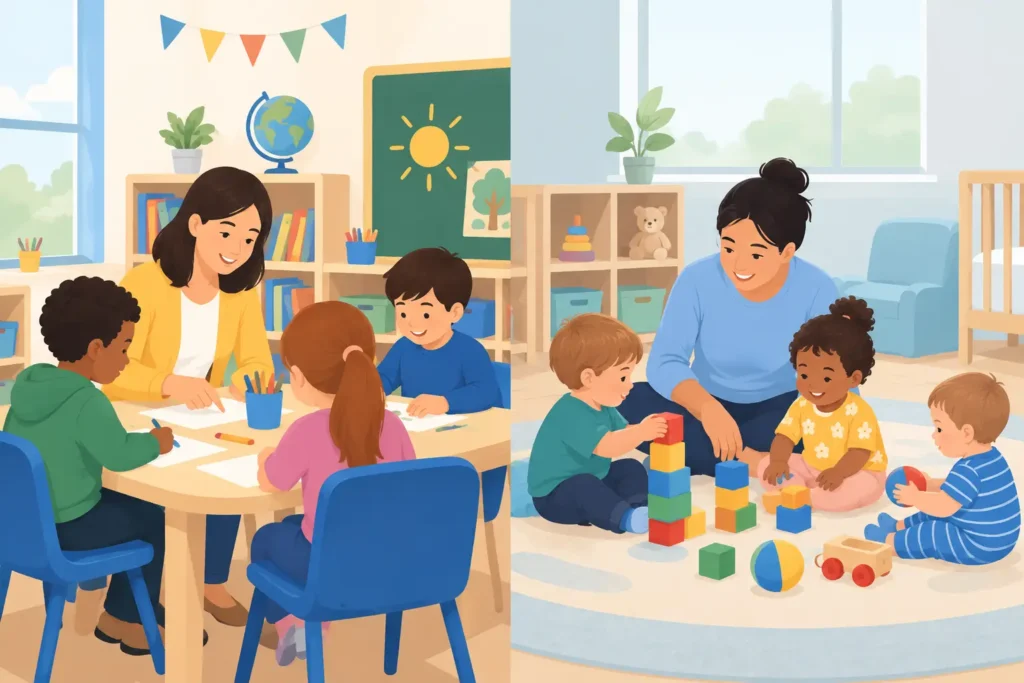
A child may happily spend a full day painting, building, listening to stories, sharing lunch, and playing outdoors in either setting. Yet the kindergarten versus daycare differences can shape how that day supports their confidence, friendships, early literacy, and readiness for the next stage of school. For parents, especially those balancing work and family life, the right choice is not simply about where a child stays during the day. It is about finding a caring environment where they feel safe, known, and encouraged to grow.
Kindergarten versus daycare differences at a glance
Kindergarten and daycare can overlap, particularly when a school offers extended care. Both should give young children warm relationships, safe supervision, opportunities for play, healthy routines, and social connection. The main difference usually lies in the purpose of the program.
Daycare is primarily designed to provide dependable care while parents work or manage other responsibilities. Quality daycare can be rich in play, conversation, movement, and age-appropriate activities. Its daily schedule often focuses on meeting children’s care needs across a longer day, including meals, rest, hygiene, free play, and transitions.
Kindergarten is an early education program with more intentional learning goals. Children are guided through activities that build communication, listening, early reading and writing, number sense, problem-solving, independence, and classroom habits. The best programs do this without making childhood feel rushed. Learning can happen while making pizza, observing water vapor, creating shapes, planting seeds, or working together on a group project.
For many families, the ideal arrangement is not an either-or decision. A kindergarten program with extended child-care support can provide purposeful learning during the school day and reliable, nurturing care before or after class.
The biggest difference: care-centered versus learning-centered
A daycare’s first responsibility is care. Parents need to know that their child will be supervised, comforted, fed, rested, and kept engaged throughout the day. This is meaningful work. Young children learn best when their physical and emotional needs are met consistently.
A kindergarten’s first responsibility is education, although care remains essential. Teachers plan experiences around what children are ready to learn and practice. A child might hear a story and talk about its characters, trace letters in sand, sort leaves by size, measure ingredients while baking, or use blocks to explore balance and geometry. These moments are playful, but they are also carefully chosen to strengthen developmental skills.
This distinction matters because a child who is nearing formal school benefits from learning how to participate in a group, follow a routine, ask questions, express ideas, and keep trying when something is difficult. Kindergarten gives those skills a regular place to grow.
Daily routines may feel different
A daycare routine is often flexible around the changing needs of young children. Infants, toddlers, and preschoolers may have different sleeping, feeding, and activity schedules. There may be generous periods for free play and quiet rest, with caregivers adapting the day as needed.
In kindergarten, the day is usually more structured. Children begin to recognize a predictable rhythm: arrival, circle time, learning centers, snack, outdoor activity, small-group work, story time, and tidy-up time. Predictability can be reassuring. It helps children understand what comes next and gradually take responsibility for simple tasks, such as putting away materials, washing hands, or preparing their own bag for home.
Structure should never mean sitting still for long periods. Young children need movement, fresh air, music, imaginative play, and time to explore with their hands. A strong kindergarten program balances teacher-guided learning with active, joyful discovery. Outdoor play is not a break from learning. It supports coordination, resilience, cooperation, and healthy minds as much as bodies.
Learning goals and school readiness
Another of the important kindergarten versus daycare differences is the focus on school readiness. This does not mean expecting every child to read chapter books or complete worksheets before they are ready. It means helping children develop the foundation that makes future learning less intimidating and more enjoyable.
In kindergarten, educators may observe how a child holds a pencil, recognizes sounds, joins a conversation, counts objects, manages frustration, and responds to a new challenge. They use these observations to offer support at the child’s level. One child may need encouragement to speak up during group time. Another may be ready to blend letter sounds or take on a more complex building project.
Reading development is often a visible part of kindergarten. Through read-alouds, songs, rhymes, letter games, picture discussions, and guided practice, children begin to see books as a source of pleasure and knowledge. English-led instruction can also give children meaningful practice in listening and speaking with growing confidence.
Daycare may introduce many of these same skills, particularly in a high-quality program. The difference is usually the consistency and depth of the educational plan. Kindergarten typically has clearer learning milestones and more regular communication about a child’s progress toward them.
Social and emotional growth belongs in both settings
Parents often ask whether kindergarten is too academic for a child who is shy, active, sensitive, or still learning to manage big feelings. The answer depends on the program. A caring kindergarten understands that social and emotional growth is not separate from learning. It is the ground learning stands on.
Children need adults who notice when they are overwhelmed, celebrate small steps, and guide them through disagreements with patience. They need chances to practice saying, “Can I have a turn?” or “I feel sad,” and to learn that being kind, respectful, and curious matters. These are not extras. They are lifelong skills.
Daycare also provides valuable social learning through shared toys, group meals, and daily play. Kindergarten may add more opportunities for teamwork, classroom responsibilities, presentations, and collaborative projects. Raising chicks, making floating boats, or preparing sushi together can teach children to listen to others, wait, care for living things, and feel proud of a shared result.
Hours, flexibility, and family routines
For working parents, practical considerations carry real weight. Traditional kindergarten may run for a shorter school day, while daycare is often available for longer hours and throughout more of the year. This can make daycare the more straightforward choice when full-day coverage is the immediate need.
However, an extended-day kindergarten can offer a thoughtful middle ground. A child receives a focused education program, then remains in the familiarity of the same safe environment for meals, rest, outdoor play, reading, and supervised activities. This can reduce the stress of multiple drop-offs, unfamiliar caregivers, or frequent transitions.
Ask each provider how they handle early arrivals, late pick-ups, school holidays, naps, meals, and communication with families. A schedule that looks convenient on paper should also feel calm and manageable for your child. Long days can work well when children have caring adults, comfortable spaces, and a rhythm that includes both activity and rest.
What to look for when choosing a program
The label on the door matters less than what children experience inside. When visiting a daycare or kindergarten, notice whether the environment feels welcoming and purposeful. Are children spoken to with warmth? Are teachers at their level, listening and responding? Do the rooms invite children to read, create, build, investigate, and play?
It is also helpful to ask how educators support children who need extra reassurance, additional language practice, or more challenge. Find out how they share progress with parents and how they approach behavior. A program that views behavior as communication is more likely to guide children with empathy while still setting clear, consistent boundaries.
Look beyond academic displays, too. Children need space to move, opportunities to be outdoors, materials that spark curiosity, and adults who recognize their individual personalities. A quiet child may be a careful observer. A busy child may be a determined explorer. In a nurturing setting, both can feel valued and capable.
At Summer Tots, this balance is central to the school day: children are encouraged through play-based learning, practical projects, outdoor experiences, reading, and character education, with extended care available for families who need it. The goal is not to hurry children forward. It is to help them grow into confident learners with happy hearts and healthy minds.
When you visit a program, picture your child arriving on an ordinary Tuesday morning. Can you imagine them being greeted by name, finding something meaningful to do, asking for help when they need it, and coming home with a small story they are proud to share? That everyday sense of safety, joy, and belonging is a very good place to begin.