
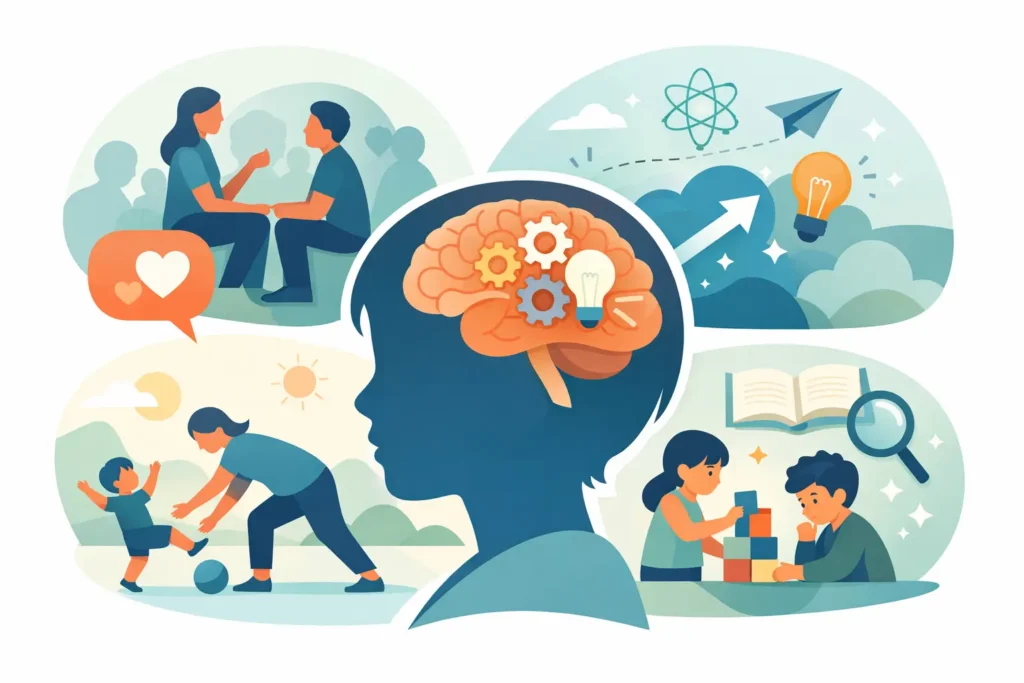
A child who proudly pours water into a cup, invites a friend to join a game, and asks why a boat floats is doing far more than staying busy. These small moments show social emotional physical and cognitive development working together. In the preschool years, children grow through movement, relationships, curiosity, mistakes, laughter, and the steady support of caring adults.
For parents, it can be reassuring to remember that development is not a race with one finish line. Every child has a different pace, personality, and set of interests. The goal is not to make children grow up faster. It is to give them a safe, joyful place where they can practice the skills that help them feel confident at school, at home, and in the wider world.
Why the Four Areas of Development Belong Together
Children do not separate learning into neat categories. When a child builds a tall block tower, they are using their hands and body to balance pieces, thinking about shape and height, handling the frustration of a collapse, and perhaps working with a friend. One activity can support many kinds of growth at once.
This is why a caring early learning environment balances teacher-guided experiences with meaningful free play. A worksheet may help a child practice a letter, but it cannot replace the communication, patience, coordination, and problem-solving that come from creating something with their own hands. Children need both gentle structure and room to explore.
Strong development also depends on relationships. A child is more willing to try a new task when they trust the adult nearby. They are more likely to use kind words when adults consistently model kindness, listen to their feelings, and guide them through difficult moments with calm boundaries.
Social Emotional Physical and Cognitive Development in Daily Life
Social and emotional growth: learning to understand self and others
Social and emotional development helps children recognize feelings, build friendships, communicate needs, and recover when something does not go their way. These are big skills for small people. Waiting for a turn, saying “Can I play?”, accepting a different idea, or trying again after spilling paint all require practice.
Children learn emotional language when adults name what they see without judgment. A teacher might say, “You look disappointed that it is not your turn yet. Let us find something to do while you wait.” This acknowledges the feeling while showing the child that feelings can be handled safely.
Character education has a place here too. Simple daily conversations about respect, empathy, honesty, and helpfulness make these values real. When children help set the table for a class activity, comfort a friend, or care gently for a small animal, they begin to see that their choices affect others.
Physical growth: building capable, healthy bodies
Physical development includes more than learning to run, jump, or climb. It also includes the small hand movements children use to hold crayons, fasten buttons, scoop ingredients, and turn pages in a book. Both large and small movements support independence and school readiness.
Outdoor play is especially valuable because it gives children space to move freely and test what their bodies can do. Running games, balancing activities, climbing, gardening, and ball play strengthen coordination, confidence, and body awareness. Fresh air and active play can also help children return indoors ready to focus.
Fine motor skills develop beautifully through purposeful projects. Rolling dough, threading beads, cutting paper, arranging geometric shapes, and making pizza or sushi invite children to use their hands with care. These activities feel like play, yet they build the control children will later use for writing and everyday self-care.
Cognitive growth: thinking, questioning, and making connections
Cognitive development is how children learn to think, remember, reason, use language, and solve problems. It is not only about knowing numbers or reciting the alphabet. A curious child who asks questions, notices patterns, and tests an idea is developing a strong foundation for future learning.
Hands-on experiences make ideas easier to understand. A child who observes water vapor, makes a floating boat, or watches chicks grow is not simply receiving an answer from an adult. They are seeing change happen, making predictions, and learning that questions are welcome.
Reading time also supports cognitive growth, especially when it is warm and interactive. Asking what a character might do next, noticing a familiar sound in a word, or retelling a favorite story strengthens language, memory, imagination, and early literacy. The best reading experiences make children feel that books are a source of comfort and discovery, not pressure.
What Purposeful Play Can Look Like
The most meaningful preschool activities often begin with an ordinary question. Why does this sink? What happens if we mix these colors? How can we make our bridge stronger? Adults do not need to have every answer ready. They can encourage children to look closely, try an idea, and talk about what happened.
Practical projects are powerful because children can see the purpose of their effort. Baking teaches measuring, sequence, patience, and cooperation. Caring for plants or animals encourages responsibility and empathy. Creating a model from recycled materials develops planning and imagination. Even cleaning up together can teach sorting, teamwork, and pride in caring for a shared space.
At Summer Tots, these experiences are designed to help children learn with happy hearts and healthy minds. An engaging project is never just a way to fill the day. It is an opportunity for a child to communicate, move, think, and feel capable.
The Value of Predictable Routines and Gentle Challenges
Children flourish when they know what comes next. A predictable arrival routine, regular mealtimes, story time, outdoor play, and a calm goodbye ritual can make the day feel secure. This security matters even more for children who are still learning to separate from parents or manage busy emotions.
Routine should not mean that every moment is rigid. Children also need choices. Choosing between two art materials, deciding which book to read, or selecting a role in pretend play gives them a growing sense of independence. The right amount of choice depends on the child. Some children confidently seek new challenges, while others need a familiar activity nearby before they are ready to try something different.
Gentle challenge is equally important. If a puzzle is too easy, a child may lose interest. If it is far too difficult, they may feel defeated. Caring educators observe closely and offer support that fits the moment: one hint, a simpler first step, encouragement to work with a friend, or time to try again tomorrow.
How Families Can Support Growth at Home
Parents do not need to turn home into a classroom. The most helpful learning often happens in ordinary family moments. Invite your child to help wash fruit, match socks, water plants, or choose vegetables at the store. Talk about what you notice together. A short conversation about a bird on the way home can build vocabulary and curiosity.
Make room for feelings as well as achievements. Instead of only asking, “What did you learn today?” try asking, “What made you happy?” or “Was there anything that felt hard?” When children know they can share both joyful and difficult moments, they build trust and emotional awareness.
It also helps to keep expectations realistic. A preschooler may be able to explain an elaborate story one day and struggle to use words when tired the next. A child who plays happily with friends may still have trouble sharing a favorite toy. Progress is often uneven, and that is normal. Consistent guidance, sleep, nutritious meals, active play, and affectionate connection all give development the support it needs.
When Extra Support May Help
Parents know their children best, and concerns deserve to be heard. If a child regularly seems unable to communicate needs, rarely engages with others, loses skills they once had, or has ongoing difficulty with movement, attention, or intense emotions, speak with their teacher and pediatrician. Early conversations do not label a child. They help adults understand what support may be useful.
A close partnership between families and educators makes a real difference. Teachers can share what they notice in group settings, while parents can describe what happens at home. Together, adults can celebrate growth, respond to challenges with consistency, and make sure the child feels understood rather than judged.
The preschool years are full of first attempts: the first brave goodbye, the first friendship repaired after an argument, the first name written with care, the first question that leads to a wonderful discovery. When children are surrounded by patient adults, purposeful play, and genuine affection, each of those attempts becomes a quiet step toward a confident future.