
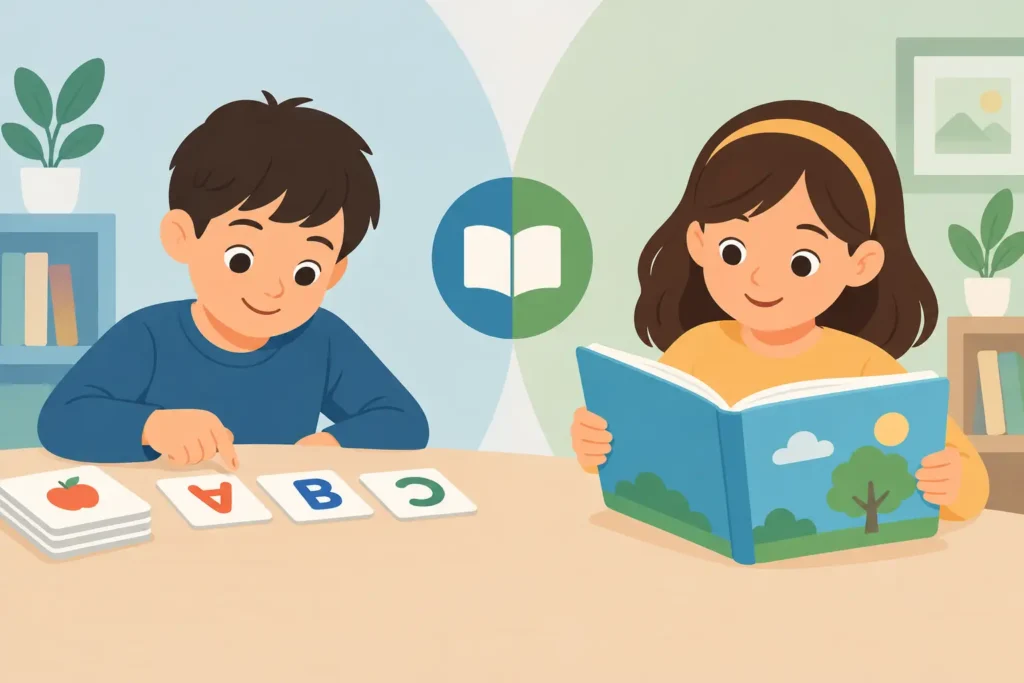
A child proudly sounding out the letters in “sun” is making an important discovery: print carries meaning. So is the child who notices that the word on a favorite book cover says the same thing every time. When parents consider phonics versus whole language reading, the real question is not which side wins. It is how children can gain the skills and confidence to read with understanding and joy.
For preschoolers and kindergartners, reading should never feel like a race. Children need caring guidance, playful practice, rich conversations, and many reassuring moments of success. They also need teaching that meets them where they are, whether they are beginning to notice letters or are ready to read simple books independently.
What Is Phonics?
Phonics teaches children the relationship between letters and sounds. They learn that the letter m usually makes the /m/ sound, that s and a can be blended to make “sa,” and that adding t creates “sat.” Over time, children use these patterns to read unfamiliar words for themselves.
This matters because English has thousands of words. A child cannot memorize every word they will meet in a book, on a sign, or in a future school assignment. Phonics gives them a practical tool for working through new words. When a child points to “map,” says each sound slowly, and then blends them into a word, they are building independence.
At this age, phonics works best when it is active and encouraging. Children might form letters with play dough, search for objects that begin with the same sound, clap out sounds in their names, or match picture cards to beginning letters. These small activities help children connect learning with movement, imagination, and accomplishment.
Phonics does have a limit when it is taught in isolation. A child may be able to sound out a word without knowing what it means. They may also lose interest if every reading moment becomes a worksheet or a test. Reading is more than decoding letters. It is also about language, ideas, feelings, and connection.
What Is Whole Language Reading?
Whole language reading grew from the idea that children learn to read naturally when they are surrounded by meaningful print, stories, and enjoyable language. It emphasizes reading real books, recognizing familiar words, using pictures and context, and understanding the message of a text.
There is much to value in this approach. Young children who listen to stories develop vocabulary, attention, imagination, and an understanding of how books work. They learn that print moves from left to right, that stories have characters and events, and that books can help us laugh, wonder, solve problems, and talk about kindness.
A child who recognizes “STOP” on a sign, spots their own name on a cubby, or remembers the repeated words in a beloved picture book is learning that written words have meaning. These are valuable early reading experiences. Reading aloud together also creates the warm, secure feeling that often makes children want to return to books again and again.
The challenge comes when children are asked to rely mainly on pictures, memory, or guesses to identify words. Pictures can support understanding, but they cannot always tell a child whether a word is “horse,” “pony,” or “farm.” Context can help, but it cannot reliably replace the ability to notice the letters and sounds in a word. For many children, especially as books become more complex, guessing is frustrating and unreliable.
Phonics Versus Whole Language Reading: Why a Balanced Approach Helps
The strongest early reading experiences bring useful parts of both approaches together. Children need explicit phonics instruction so they can decode words. They also need a language-rich environment so they understand why reading matters.
Think of phonics as one of the tools children carry into a book. It helps them open the door to unfamiliar words. Storytelling, conversations, vocabulary, background knowledge, and comprehension help them enjoy what is inside the room.
A balanced approach does not mean teaching every method in equal amounts, every day. It means giving children clear instruction in sounds and letter patterns while surrounding that instruction with meaningful reading and writing. A teacher may introduce the sound /b/ through a short game, invite children to make a “b” with craft materials, and then read a story about a bear. Later, children might draw a bear, attempt to write the first sound they hear, and tell a friend about their picture.
This kind of learning feels connected. Children are not simply memorizing letters, and they are not being asked to guess their way through books. They are learning that sounds, words, stories, and their own ideas belong together.
What Reading Growth Can Look Like in Preschool and Kindergarten
Early literacy develops in small, meaningful steps. One child may begin by enjoying rhymes and noticing the first sound in “mom.” Another may already recognize many letters but need help blending sounds. A third may read a few familiar words confidently yet need more support in understanding what a story means.
Parents often look for visible progress, and that is natural. Still, progress does not always arrive as a sudden leap into independent reading. It can look like a child choosing books more often, retelling a favorite story, asking what a sign says, recognizing the letters in their name, or trying to write a message for a family member.
A nurturing classroom makes room for these different starting points. Educators can listen carefully, offer the next manageable challenge, and celebrate effort without comparing children to one another. When children feel safe making mistakes, they are more willing to try a new sound, read aloud, or ask for help.
At Summer Tots, reading development can be part of a larger day filled with conversation, play, practical projects, outdoor discovery, and friendships. A child making a floating boat or preparing a simple snack has new words to use. A child observing water vapor has a real experience to describe. These moments build the knowledge and language that make books easier to understand later.
How Parents Can Support Reading at Home
You do not need to turn home into another classroom. A few calm, consistent habits can make a meaningful difference. Read aloud every day, even when your child seems more interested in turning pages than listening closely. Let them choose favorite books repeatedly. Repetition is not boredom for young children; it is practice, comfort, and a chance to notice something new.
As you read, talk naturally. You might ask, “What do you think will happen next?” or “How do you think the character feels?” Pause to explain an interesting word, connect the story to your child’s life, or let them retell part of the book in their own words. These conversations strengthen comprehension without making story time feel like a lesson.
You can also notice sounds in everyday life. Point out the first letter in a food label, play a rhyming game in the car, or invite your child to listen for the beginning sound in “ball” or “tree.” If they are ready, help them stretch out simple words slowly and blend the sounds together. Keep the mood light. If frustration appears, return to a book, a song, or another activity and try again later.
Avoid putting pressure on children to perform for relatives or comparing their reading to a sibling or classmate. Some children begin reading early, while others need more time to develop the language, attention, and confidence that support reading. What matters most is steady encouragement and teaching that responds to the individual child.
Choosing the Approach That Builds Confident Readers
For most young children, phonics should be taught clearly and directly, because it gives them a dependable path into unfamiliar words. But phonics becomes far more powerful when it lives alongside picture books, songs, conversations, pretend play, writing attempts, and real-world discovery.
The goal is not a child who can recite sounds without joy, nor a child who loves books but feels lost when facing a new word. The goal is a child who sees reading as both possible and meaningful. With patient adults beside them, children can grow into readers who sound out, understand, question, imagine, and proudly say, “I can read this.”