
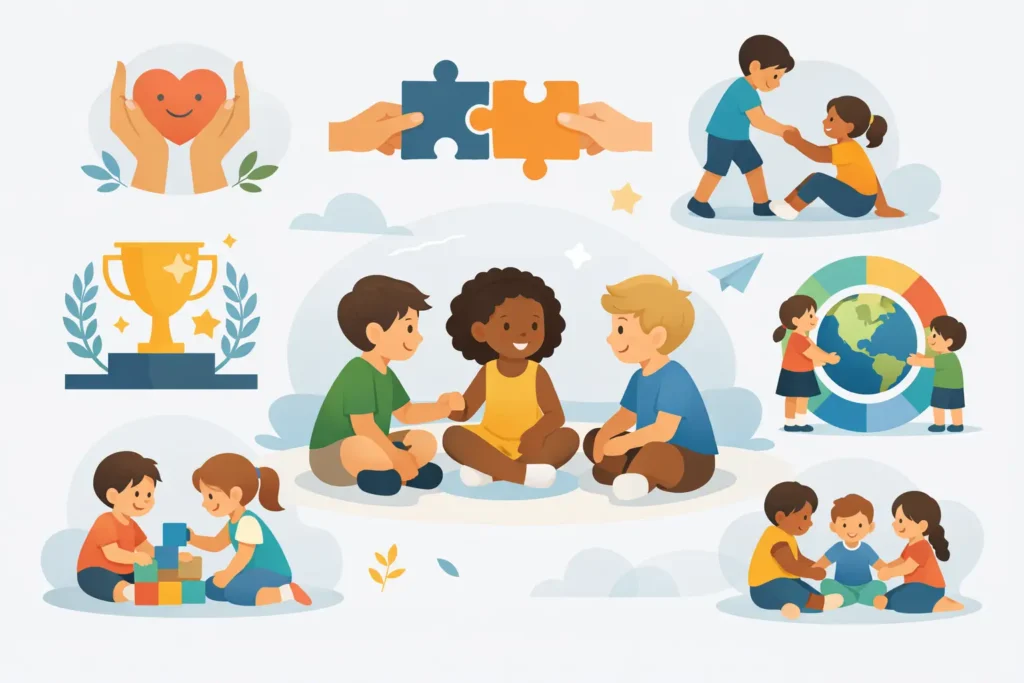
A preschooler who offers a friend the last red crayon, waits patiently for a turn on the slide, or says, “Are you okay?” after a tumble is learning something bigger than good manners. These small moments are the heart of character education activities for preschoolers. They help children practice the kindness, courage, self-control, and respect that make classrooms feel safe, friendships feel joyful, and new experiences feel less daunting.
At this age, children do not learn character from long talks alone. They learn it through repetition, play, caring relationships, and adults who gently guide them through real-life moments. A child may understand that sharing is kind one day and still struggle to share a favorite toy the next. That is completely normal. Character grows slowly, one meaningful practice at a time.
Why Character Learning Begins in the Preschool Years
Preschool is often a child’s first regular community outside the family. They are learning to communicate their needs, notice other people’s feelings, recover from disappointment, and contribute to a group. These are big tasks for small children.
When character lessons are woven into everyday learning, children can connect values with action. Instead of simply hearing “be responsible,” they help water a plant, put materials away, or remember to feed classroom chicks. Instead of being told to be brave, they try climbing one more step, speak during circle time, or taste a food they helped prepare.
The goal is not perfect behavior. Young children need room to make mistakes, feel strong emotions, and receive calm support. What matters is helping them name what happened, understand the effect of their choices, and try again.
7 Character Education Activities for Preschoolers
1. Create a Kindness Helper Routine
Give children simple, real opportunities to help each other throughout the day. One child might pass out napkins at snack time, another might hold the door, and another might help a friend find a missing shoe. Rotate these jobs so every child experiences being a helpful member of the group.
Afterward, keep the conversation specific: “You noticed that Maya needed help carrying her blocks. That was thoughtful.” Specific praise helps children recognize what kindness looks like in practice. It also avoids turning helping into a competition for approval.
At home, this can be as simple as inviting a child to match socks, place fruit in a bowl, or bring a book to a younger sibling. The task does not need to be perfect to be meaningful.
2. Use Story Time to Talk About Feelings and Choices
Books give preschoolers a safe way to explore difficult feelings before they are in the middle of one. Pause during a story and ask, “How do you think this character feels?” or “What could they do next?” Let children offer their own ideas, even if their answers are surprising.
Stories about friendship, frustration, honesty, and bravery are especially useful because children can see that everyone has challenging moments. A character who makes a poor choice and makes amends can be more helpful than a character who always behaves perfectly.
Keep questions short and concrete. A three-year-old may not be ready to explain a complicated motive, but they can often identify a sad face, a worried voice, or a kind action. Over time, these conversations build empathy and language for managing feelings.
3. Practice Taking Turns Through Cooperative Play
Turn-taking is a daily lesson in patience, fairness, and self-control. Games work best when the focus is on enjoying the group experience rather than winning. Roll a ball back and forth, build one tall block tower together, or create a mural where each child adds a section.
When waiting feels hard, acknowledge it instead of expecting instant calm: “Waiting is tough. Your turn is coming after Jordan.” A visual cue, such as holding a turn card or watching a sand timer, can make the wait easier to understand.
Cooperative activities are particularly helpful for children who become frustrated by competitive games. They learn that another child’s success does not take away from their own joy. Everyone can contribute to a floating boat project, a pretend restaurant, or a garden bed.
4. Grow Responsibility by Caring for Living Things
Children take responsibility seriously when they can see the result of their care. A classroom plant, a small herb garden, or a carefully supervised animal-care routine gives them a gentle reason to remember, observe, and follow through.
Invite children to help water plants, check whether soil is dry, or notice a new leaf. If a class raises chicks or observes caterpillars, educators can talk about quiet hands, gentle voices, and the importance of meeting an animal’s needs. These experiences encourage respect for living things while nurturing curiosity.
There is a useful trade-off here: children should have meaningful responsibilities, but adults still need to keep the task manageable. A child may carry a small watering cup rather than a heavy bucket. Success builds confidence; tasks that are too difficult can lead to discouragement.
5. Make a Calm-Down Corner Together
Self-control does not mean children never cry, shout, or feel angry. It means they gradually learn safe ways to respond when emotions feel too big. A calm-down corner can include soft cushions, picture books, a feelings chart, or a basket with sensory items such as a soft toy and a pinwheel for slow breathing.
Let children help choose or create parts of the space. They might draw faces for happy, sad, angry, and worried feelings, or decorate a small “I need a break” sign. When they have helped make it, the area feels less like a punishment and more like a supportive place to reset.
Adults can model the language children need: “Your tower fell down, and you are angry. Let’s take three slow breaths, then decide what to do.” Some children will use the space quickly, while others need an adult nearby at first. Both responses are normal.
6. Solve Everyday Problems With Puppets
Puppets make social problems feel less personal and more playful. Use two simple puppets to act out familiar preschool situations: both want the same truck, one child accidentally knocks over another child’s work, or someone is left out of a game.
Stop the scene before it is solved and ask children what the puppets could say or do. Encourage practical words such as “Can I have a turn when you are done?” “I’m sorry,” “Do you want to play?” and “Let’s build it again.” Then let children try the ideas through the puppets themselves.
This activity builds communication as well as empathy. A child who freezes during a real conflict may be able to rehearse the words through a puppet first. With practice, those words become easier to use on the playground and at home.
7. Celebrate Effort, Honesty, and Making Things Right
Character education is strongest when children see that effort matters, mistakes can be repaired, and honesty is safe. If a child spills paint, breaks a crayon, or denies taking a toy, begin with calm curiosity rather than shame. “Something happened here. Let’s figure out how we can help.”
Children can help wipe up the paint, tape a torn page, return an item, or offer a sincere apology. The repair should fit the situation and remain simple. A forced apology without understanding may sound polite, but it does not teach much. It is more meaningful to help a child notice the effect of their action and choose a way to care for the other person.
Praise the process: “You told the truth even though you were worried. That was brave.” This teaches children that honesty and responsibility are part of feeling secure in their community.
Helping Character Lessons Carry Into Home Life
Consistency between home and school helps children understand that values are not just classroom rules. Families do not need a detailed lesson plan. Everyday routines offer many chances to practice respect, responsibility, and empathy.
A parent might ask, “What was one kind thing you did today?” during the ride home, or invite a child to help set the table before dinner. When conflicts happen between siblings, focus on guiding each child through the next helpful step rather than deciding who is “the bad one.” Children learn more when they feel loved while being held accountable.
At Summer Tots, caring educators can make these lessons feel natural through stories, outdoor play, practical projects, and warm daily guidance. When children are surrounded by adults who notice their efforts and help them try again, they begin to see themselves as capable, caring people.
The most lasting character lessons often happen in ordinary moments: a child offering a hand, trying again after a setback, or finding the words to say, “You can play with me.” Those little choices are how happy hearts and healthy minds take root.