
A preschooler’s block tower falls just before it is their turn to show the class. Their face tightens, tears begin, and they look to an adult for what happens next. This everyday moment is where parents and educators learn how to build child resilience: not by asking a child to stop feeling upset, but by helping them feel safe enough to try again.
Resilience is a child’s growing ability to recover after disappointment, manage big feelings, adapt to change, and keep going when something feels difficult. For young children, it does not look like staying cheerful all the time. It may look like taking a breath after crying, asking for help, waiting for another turn, or returning to a puzzle after saying, “I can’t do it.”
Start With Safety and Connection
Children are more willing to take healthy risks when they trust that a caring adult is nearby. A child who knows they will be listened to after a hard day is better able to face the hard day itself. Connection is not a reward for good behavior. It is the steady foundation that makes learning, independence, and confidence possible.
This begins with small, reliable moments. Greet your child warmly in the morning. Notice when they are quiet or frustrated. Make time for a short conversation after school, even if the questions are simple: “What made you smile today?” or “Was there anything that felt tricky?” Young children do not always have the words for their experiences, so patience matters as much as the question.
When emotions rise, stay close before trying to solve the problem. You might say, “You really wanted to keep playing. It is hard when playtime ends.” Naming the feeling helps children understand that disappointment is manageable, not frightening. Once they are calmer, they can begin to think about what to do next.
Let Children Practice Small Challenges
Parents naturally want to protect their children from distress. Yet stepping in too quickly can send an unintended message: “You cannot handle this.” A better approach is to offer support without taking over.
If your child struggles to zip a jacket, pause before doing it for them. Try, “That is frustrating. Would you like me to hold the bottom while you pull the zipper?” If they are unsure about joining a group game, stay nearby and help them find one simple opening: “You could ask, ‘Can I play too?’” The goal is not to leave a child alone with a challenge. It is to give them a manageable part in solving it.
The right level of challenge depends on the child. Some children enjoy trying new activities immediately, while others need to watch first or begin with a familiar friend. A child who is tired, hungry, or adjusting to a new classroom may need more help than usual. Resilience grows through repeated experiences of “This was hard, and I got through it,” not through overwhelming pressure.
Use Play to Build Flexible Thinking
Play gives young children a natural, joyful way to practice resilience. In pretend play, a child can be the veterinarian whose animal needs care, the builder whose bridge falls down, or the shopkeeper who has to find a different item when the first choice is gone. These little stories allow children to explore problems and solutions without the weight of a real-life consequence.
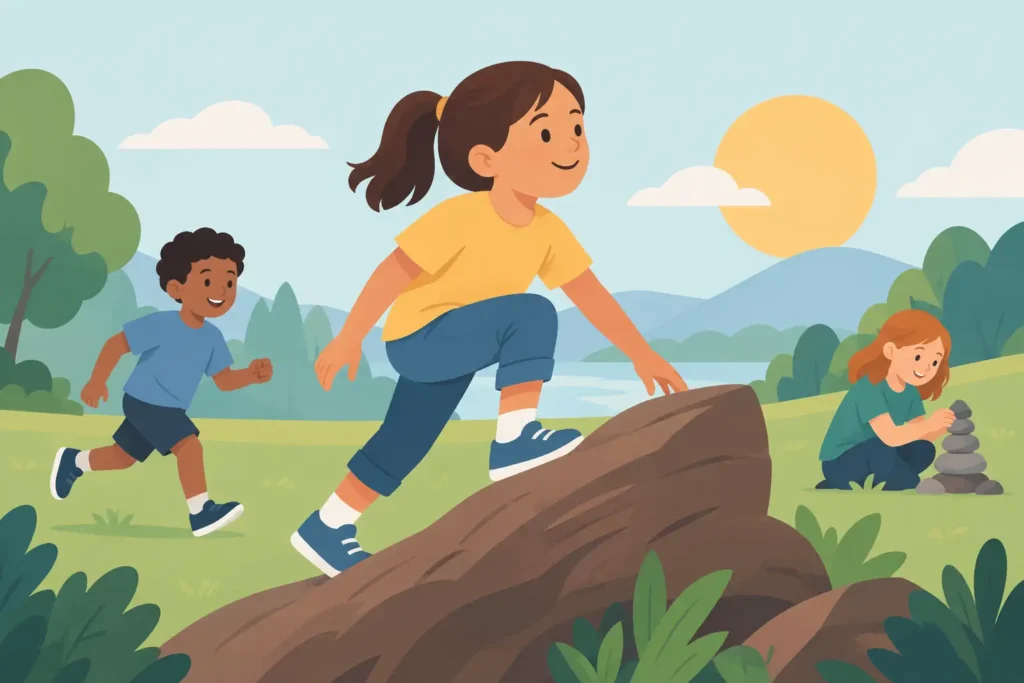
Outdoor play is especially valuable. Climbing, balancing, running, digging, and navigating games with friends require children to make choices, assess their abilities, and recover from minor setbacks. A missed catch or a wobbly step becomes a chance to try a different approach. Adult supervision keeps children safe, while room to explore helps them discover what their bodies and minds can do.
Hands-on projects can offer the same lesson. A floating boat may sink before a child changes its shape. Pizza dough may not look as expected before it becomes a delicious snack. Seeds may take time to sprout. These experiences teach a gentle but powerful truth: effort does not always create instant results, and trying again can lead to something new.
Teach Feelings, Not Just Behavior
A resilient child needs more than the instruction to “be good.” They need language for what is happening inside them and respectful ways to respond. This is a skill that develops gradually, especially in the preschool and kindergarten years.
Help your child build a simple feelings vocabulary: happy, worried, disappointed, angry, embarrassed, excited, and proud. During calm moments, talk about what these feelings can look like in the body. Anger might bring a hot face or tight fists. Worry might feel like butterflies in the stomach. When children notice these signals, they have a better chance of using a coping tool before a feeling becomes too big.
Keep the tools simple. A child may take three slow breaths, squeeze and release their hands, sit in a cozy quiet space, get a drink of water, or ask for a hug. These are not ways to make emotions disappear. They are ways to create enough calm for a child to choose what comes next.
Adults can also model this openly. “I am disappointed that it is raining because I planned a park visit. Let’s think of another fun plan.” Children learn from seeing that feelings and problem-solving can exist together.
Praise Effort Without Pretending Everything Is Easy
Encouragement matters, but children can tell when praise does not match their experience. Saying “That was easy!” after a child has struggled may make them feel unseen. More meaningful encouragement is specific, honest, and focused on the process.
Try noticing what your child did: “You kept working on that puzzle even when the pieces did not fit at first.” Or, “You were nervous about speaking, but you said hello to your teacher.” This helps children connect progress with persistence, preparation, and courage rather than believing that success only belongs to people who get things right immediately.
It is also helpful to make room for outcomes that are not perfect. A drawing can be different from what a child imagined. A game can be lost. A friend may say no to playing. These moments sting, but they are opportunities to ask, “What could help now?” Perhaps the answer is trying again, choosing another activity, practicing a skill, or simply having a few minutes to feel sad.
Build Resilience Through Everyday Responsibility
Age-appropriate responsibilities tell children that they are capable contributors to family life. They do not need to be large tasks. Putting toys away, carrying napkins to the table, watering a plant, choosing clothes, or helping pack a school bag can all build confidence.
Expect mistakes along the way. Milk may spill. Socks may be mismatched. A child may forget an item after helping to pack. Instead of turning every mistake into a lecture, guide the repair: “The milk spilled. Let’s get a cloth and clean it together.” Responsibility becomes empowering when children learn that errors can be handled with care.
Predictable routines also support resilience. When children know what generally happens before school, at mealtimes, and before bed, they use less energy worrying about what comes next. A routine should not be so rigid that change feels alarming, though. Small, supported changes, such as a new snack, a different route home, or a visit with a trusted caregiver, help children practice flexibility.
Create a Consistent Home-School Partnership
Children benefit when the important adults in their lives share information and work toward the same goal. If a child is finding drop-off difficult, having friendship worries, or becoming frustrated with early reading, a brief conversation between parent and teacher can make a real difference. One adult may notice patterns another has not seen.
At Summer Tots, resilience can grow through caring relationships, purposeful play, outdoor exploration, and gentle guidance in kindness and respect. At home, families can continue the same message: feelings are welcome, mistakes are part of learning, and help is always available.
There will be days when your child seems confident and days when they need extra closeness. That is not failure or a step backward. Growth in the early years is rarely a straight line. Each patient response, each chance to try again, and each loving reminder that “You can do hard things, and I am here with you” helps shape a child with a happy heart, a healthy mind, and the courage to meet tomorrow.