
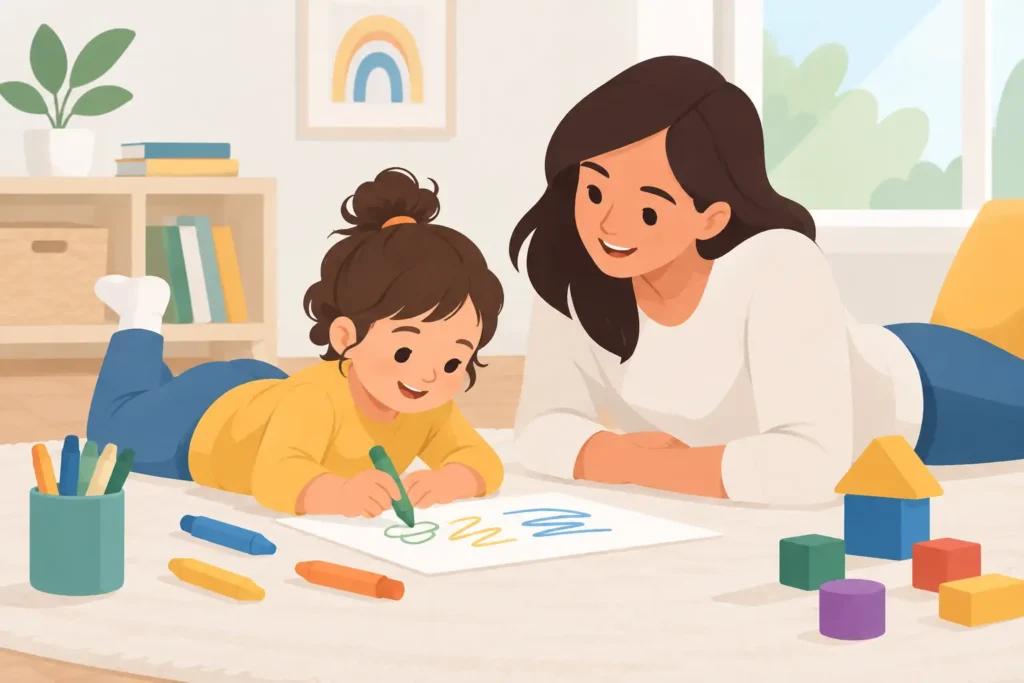
A child who proudly shows you a page filled with loops, lines, or a few wobbly letters is already taking an important step toward writing. Those marks may not look like words yet, but they carry a powerful message: “I have something to say.” Knowing how to encourage early writing means protecting that eagerness while gently giving children the skills to express themselves.
For preschool and kindergarten children, writing grows best through joyful experiences, not worksheets or pressure to form perfect letters. When children feel safe to experiment, talk, draw, build, and make mistakes, writing becomes part of their natural play. With patience and a few simple routines, families can help children develop confident hands, curious minds, and a happy relationship with books and language.
Early writing begins before letters
Writing is much more than holding a pencil and copying the alphabet. Before children can write recognizable letters, they need opportunities to strengthen their fingers, coordinate their eyes and hands, listen to sounds in words, and understand that marks can share an idea.
A child drawing a map of a pretend treasure hunt is practicing early writing. So is a child making “tickets” for a living room train ride, signing a painting with a few invented letters, or watching an adult write down a grocery list. These small moments help children see writing as useful, creative, and connected to everyday life.
It is also normal for progress to look uneven. One child may be eager to write their name at four, while another may spend more time drawing detailed pictures before showing interest in letters. Both paths can be healthy. The goal is not to rush children into formal handwriting, but to give them many meaningful reasons to communicate.
Create a home space that invites writing
Children are more likely to write when materials are easy to reach and there is no fear of getting it wrong. A small basket with blank paper, crayons, washable markers, pencils, stickers, and a clipboard can be more inviting than a formal desk. Keep it in a place where your child already enjoys spending time, such as near the kitchen table or in a quiet play corner.
Variety matters. Large paper on the floor encourages broad arm movements, while small notebooks can make children feel like real authors. Chalk on an outdoor surface, paintbrushes dipped in water, finger tracing in sand, and magnetic letters offer different ways to explore shapes and symbols. These experiences are especially helpful for children who are not yet comfortable with a pencil.
Try to avoid correcting every reversed letter, uneven line, or unusual spelling. Early attempts are evidence of thinking. If your child writes “KT” for cat, you might say, “You heard the sounds in cat. I can see the c and t sounds you noticed.” Encouragement like this builds confidence while drawing attention to language.
Make writing part of real family life
Children learn that writing matters when they see adults using it for genuine purposes. Let your child help write a reminder note, label a snack container, make a birthday card, or add an item to a shopping list. They can contribute in whatever way matches their current stage, from a scribble beside your words to a carefully copied first letter.
Talking as you write is valuable. You might say, “I am writing milk. Milk starts with /m/,” or “I need to leave a space before the next word.” Keep the tone light. This is not a lesson to test your child, but a chance to let them peek into the process of turning thoughts into print.
Build strong hands through play
Small hand muscles need time to develop. Children who find pencils tiring or frustrating may benefit more from playful hand-strength activities than from extra handwriting practice. Squeezing play dough, rolling small balls, using tongs to move pom-poms, tearing paper for a collage, threading large beads, and opening containers all support the control children later use for drawing and writing.
Outdoor play helps, too. Climbing, digging, carrying watering cans, and making marks with sticks in the dirt strengthen the shoulders, arms, and hands. These larger movements provide a foundation for the smaller, more precise movements of writing.
When your child does use a writing tool, choose one that feels comfortable. Short crayons and chunky pencils can be easier for small hands to control. A relaxed grip will develop over time, so there is no need to repeatedly adjust a young child’s fingers unless an educator or health professional has raised a concern.
Give children something worth writing about
The most meaningful writing often follows a real experience. After baking muffins, ask your child if they would like to draw the steps and add a few labels. After a rainy-day walk, invite them to make a weather journal. Following a trip to the park, they might create a simple book about the insects, leaves, or friends they saw.
At Summer Tots, hands-on projects such as making floating boats, observing water vapor, preparing pizza, or caring for living things give children rich experiences to talk about, draw, and record. At home, the same idea can be simple: let children help measure ingredients, plant seeds, wash toy animals, or build a cardboard house. Conversation comes first, and writing can follow naturally.
Ask open questions that help children reflect: “What should we call your picture?” “What happened first?” “Would you like me to write your words underneath?” When adults write down a child’s dictated story, children learn that their ideas deserve to be heard. You can then invite them to add their own marks, letters, or name.
Read together to grow writers
Reading and writing develop side by side. As you read favorite stories, point out that print carries the words you are saying. Notice a child’s name on a page, look for familiar letters on a sign, or pause to wonder what a character might write in a note.
After reading, offer a gentle invitation rather than an assignment. Your child may want to draw a new ending, make a card for a character, or create a menu for the bear in the story. Even if they choose only to talk about the book, they are building the vocabulary and ideas that support future writing.
Rereading is especially helpful. Children love knowing what comes next, and familiar stories make it easier to notice rhymes, repeated phrases, and letter patterns. A child who confidently “reads” a repeated line is beginning to understand that spoken language and written words are connected.
How to encourage early writing without pressure
The right amount of support depends on your child. Some children welcome a challenge, while others need more time to observe and play. Watch for signs of fatigue or frustration, such as gripping tightly, avoiding the activity, or becoming upset when a letter does not look right. In those moments, step back. Suggest drawing, writing with chalk, or returning later after a movement break.
Praise effort and meaning more often than neatness. Instead of saying, “That is a perfect A,” try, “You kept trying until you made the lines meet,” or “Tell me about the message you wrote.” This helps children understand that writing is a process, not a performance.
It also helps to keep comparisons out of the conversation. Every child develops at their own pace, and confidence can disappear quickly when writing becomes a competition. Celebrate the small steps: choosing a pencil, making intentional marks, recognizing the first sound in a name, or proudly signing a picture.
When to seek extra guidance
Most early writing differences are simply part of development. Still, it may be helpful to speak with your child’s teacher or pediatrician if your child consistently avoids using either hand, has significant difficulty with everyday hand tasks, experiences pain while drawing or writing, or seems unusually distressed by activities involving marks and letters.
A caring educator can share observations from the classroom and suggest playful ways to support your child. Partnership between home and school gives children a steady message: the adults around them believe in their ability to grow.
Offer paper, share stories, welcome the scribbles, and make room for your child’s ideas. Long before they write a full sentence, they are learning that their voice has a place on the page.