
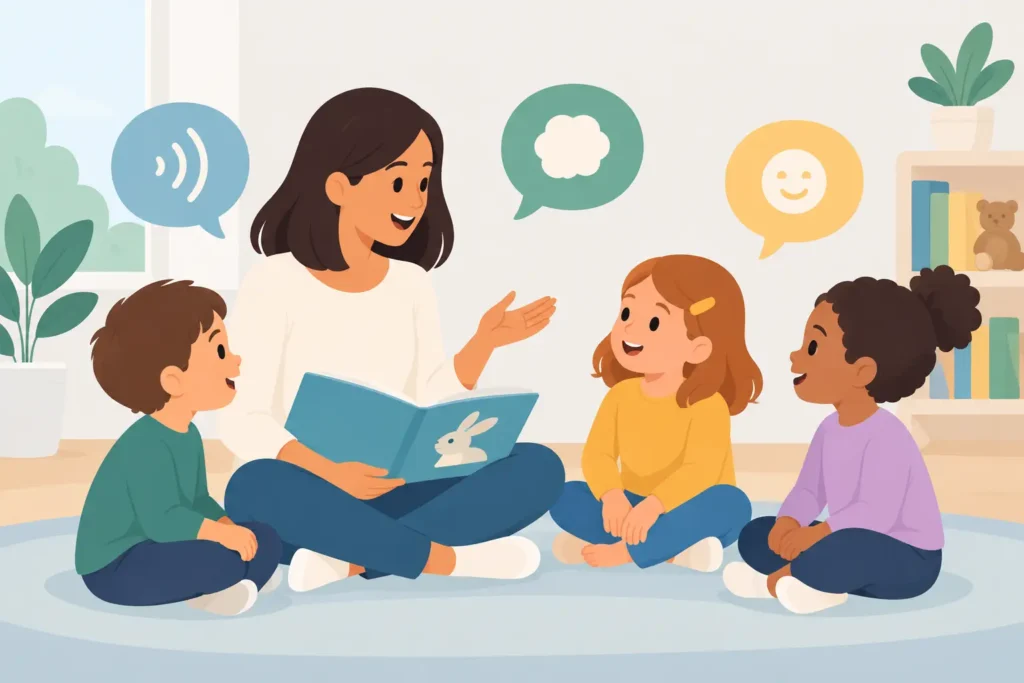
A child who once pointed to a snack may suddenly explain exactly why the banana is “too squishy.” A quiet child may begin singing a classroom song all the way home. These everyday moments are language development milestones, and they show how children are learning to share their thoughts, needs, questions, and wonderful ideas with the people around them.
For preschool and kindergarten families, language growth is about much more than saying more words. It supports friendships, early reading, problem-solving, confidence, and a child’s ability to take part in the world. Every child follows a personal path, but knowing what growth often looks like can help parents celebrate progress and seek support when needed.
What language development includes
Language development has several connected parts. A child may understand many more words than they can say. They may speak confidently but still be learning how to listen, take turns in a conversation, or tell a story in order. These skills grow together through warm, repeated interactions.
Receptive language is what a child understands. This includes following directions, answering questions, and making sense of stories. Expressive language is what they communicate through words, gestures, facial expressions, drawing, and eventually writing. Social language helps children join play, respond to others, negotiate, and show kindness when a friend is upset.
Speech clarity is related, but it is not the whole picture. Young children are still learning to make certain sounds, so some words may be hard to understand. What matters is steady growth in their ability to communicate and connect.
Language development milestones from ages 3 to 6
Age ranges are helpful guideposts, not deadlines. A child who is new to English, hears more than one language at home, or has a naturally quiet temperament may show their skills differently. Continue speaking the language that feels most natural and loving in your family. A strong foundation in any home language supports learning another language too.
Around age 3: Words become little conversations
Many 3-year-olds can use short sentences to ask for help, describe what they want, and talk about familiar people or events. You may hear questions such as “Where Daddy go?” or “What’s that?” They often enjoy naming pictures in books, joining familiar rhymes, and following simple two-step directions such as “Put your shoes away and wash your hands.”
At this age, children are discovering that words can help them enter play. They may say, “My turn,” “Come play,” or “I have a truck.” They are also beginning to use language for feelings, although a tired or frustrated child may still communicate with tears or big reactions. Gentle adults can give them words to borrow: “You are disappointed because the block tower fell.”
Around age 4: Stories, questions, and imaginative play
By age 4, many children speak in longer sentences and can be understood by people outside the family most of the time. They often love “why” and “how” questions because their curiosity is growing quickly. A child may tell you about a class activity, though the details can arrive in an amusing order.
Pretend play becomes a powerful language builder. When children make a restaurant, a doctor’s clinic, or a spaceship from boxes and blankets, they practice new vocabulary and social phrases. They learn to explain roles, make plans, and respond to another child’s ideas. A teacher who joins the play with an open question, such as “What does this patient need?” can extend the learning without taking over.
Children at this stage also begin hearing the sounds inside words. They may notice rhymes, clap syllables in names, or recognize the first sound in a familiar word. These playful listening skills help prepare them for reading.
Around age 5: Clearer ideas and early literacy
Many 5-year-olds can hold a back-and-forth conversation, retell the main parts of a familiar story, and use more specific words to describe what they see or feel. Instead of simply saying “big,” they may experiment with words like “enormous,” “heavy,” or “scary.” Their sentences become more detailed as they gain experiences to talk about.
They are also learning that print carries meaning. Some children recognize letters in their names, hear beginning and ending sounds, or try to write labels, cards, and messages. Spelling may be inventive, and that is part of the learning process. When a child writes “KT” for “cat,” they are showing that they can hear and represent important sounds.
Around age 6: Building confident communicators
As children move into kindergarten, they often become more able to explain their thinking, ask for clarification, and tell stories with a beginning, middle, and end. They can follow directions with several parts and are learning to adjust how they speak for different situations, such as talking to a teacher, a friend, or a younger sibling.
Early reading and writing grow alongside spoken language. Children benefit from hearing rich stories, talking about characters, predicting what may happen next, and connecting books to their own lives. The goal is not to rush every child into advanced reading. It is to help them see language as useful, joyful, and full of possibility.
Everyday ways to support language growth
Children do not need flashcards or lengthy lessons to build strong communication skills. They need responsive adults, meaningful experiences, and time to talk. A conversation while packing lunch or walking to the car can be just as valuable as a planned learning activity.
Try pausing after you ask a question. Young children often need a few extra seconds to organize their thoughts. Rather than correcting every grammar mistake, repeat their message back in a natural, expanded form. If your child says, “Dog runned,” you might respond, “Yes, the dog ran very fast!” They hear the correct form while feeling understood.
Reading together every day remains one of the kindest and most effective habits a family can share. Let your child turn pages, notice pictures, finish a familiar line, or ask questions. You do not have to read every word exactly as written. Talking about the story is part of reading too.
Purposeful hands-on activities create real reasons to use new words. Baking can bring in words such as mix, measure, sticky, and melt. Planting seeds invites children to observe, compare, predict, and describe change. Building a floating boat from recycled materials encourages them to test an idea, explain what happened, and try again. When learning is active, vocabulary has a place to live.
At Summer Tots, children are given opportunities to talk through play, practical projects, outdoor discovery, books, and shared routines. A child observing water vapor, preparing pizza, or caring for chicks is not only learning about the world. They are gaining the words and confidence to describe it.
When a little extra support may help
It is wise to trust your instincts if you have ongoing concerns. Consider speaking with your child’s teacher, pediatrician, or a qualified speech-language professional if your child rarely responds to their name or familiar directions, has difficulty communicating basic needs, loses skills they once had, or becomes consistently frustrated because others cannot understand them.
Support is not a label and it is not a reflection of a child’s potential. Early guidance can make communication easier and help a child feel more confident. Teachers can also offer helpful observations because children may use language differently at school than they do at home.
The most encouraging thing a parent can do is keep the connection warm. Listen closely to your child’s unfinished stories, answer their questions when you can, and let them know their words matter. Each new sentence, silly rhyme, and carefully chosen “why” is helping build a confident voice for the years ahead.