
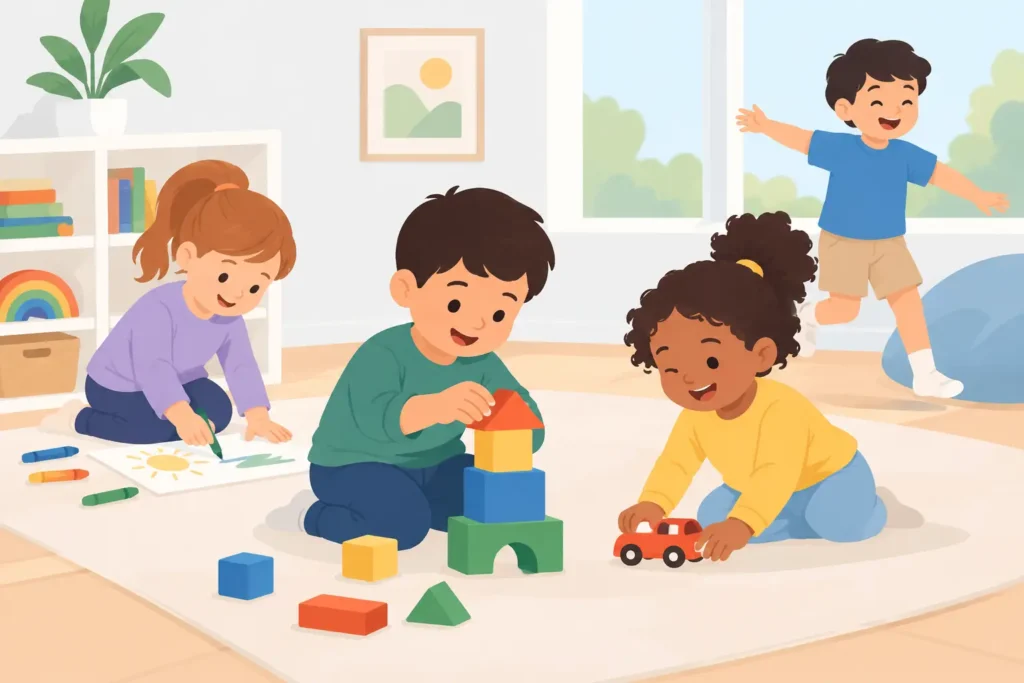
A preschooler carefully balancing blocks into a tall tower is doing far more than passing time. When the tower tumbles, they feel disappointment, try a new idea, ask a friend for help, and proudly begin again. This is why do preschoolers need play is such a meaningful question for parents: play is where young children practice the skills that help them feel capable at school, at home, and with others.
For young children, learning is most powerful when it feels active, joyful, and safe. A worksheet may introduce an idea, but play gives that idea a purpose. Children can count cups while preparing pretend tea, discover balance while building a bridge, and develop new words while explaining their imaginary adventure. These small moments help create happy hearts and healthy minds.
Why Do Preschoolers Need Play for Healthy Growth?
Preschoolers are still learning how their bodies, feelings, and relationships work. Play brings these areas together naturally. When children run outdoors, climb, dance, or navigate an obstacle course, they strengthen coordination, balance, and body awareness. They also release energy in a positive way, which can make it easier to settle into quieter activities such as listening to a story or practicing early writing.
Just as importantly, play helps children understand their emotions. A child pretending to be a doctor may be working through worries about a recent checkup. A child caring for a doll may be practicing gentleness and empathy. In a make-believe restaurant, children learn that a friend may have a different idea about who gets to be the chef. With caring guidance from an educator, these everyday disagreements become chances to use words, take turns, and find a fair solution.
This does not mean that every moment needs to be unplanned. Preschoolers thrive with a reassuring rhythm to their day. They need time for meals, rest, stories, routines, and focused learning too. The difference is that purposeful play gives children room to explore within that secure structure.
Play Builds Skills Children Will Use in School
Some parents understandably wonder whether play takes time away from academic preparation. In a thoughtful preschool setting, play supports academic readiness rather than competing with it. Children learn best when they can touch, test, question, and repeat.
Consider a simple water activity. As children pour, scoop, and watch objects float or sink, they are developing early science thinking. They notice changes, make predictions, and compare results. When an educator asks, “What do you think will happen next?” children learn that their ideas matter. The activity may later lead to new vocabulary, drawing observations, or a conversation about water vapor.
Hands-on projects can make literacy and math feel equally meaningful. Baking introduces counting, measuring, sequencing, and following directions. Making geometric forms lets children see shapes from different angles. Preparing pizza or sushi invites conversation, fine-motor practice, and confidence in completing a real task. These experiences give children something to talk about, describe, draw, and remember.
Language Grows Through Shared Play
Language is not built only by memorizing letters. It grows through warm conversations. During block play, children learn words such as “higher,” “under,” “between,” and “steady.” During dramatic play, they practice full sentences as they greet customers, explain a problem, or tell a story.
For children learning English, a play-based environment can be especially encouraging. They hear useful words repeatedly in a natural context and can connect those words to actions, objects, and feelings. A child may first point to a red apple, then say “apple,” and eventually explain, “I am making lunch for my friend.” Patient teachers can extend that language without making a child feel pressured or afraid of making a mistake.
Problem-Solving Starts With Small Challenges
Play gives preschoolers manageable problems to solve. How can we make this boat float? What happens if we use a wider base for the tower? How can everyone join the game? These questions invite children to think, try, adjust, and persist.
Adults do not need to provide every answer. In fact, stepping in too quickly can take away a valuable learning moment. Children need support, especially when they are frustrated, but they also need the satisfaction of discovering, “I did it.” That confidence carries into reading, writing, friendships, and future classroom challenges.
Friendship and Character Need Practice
Kindness is not a lesson children simply hear once and remember forever. It is a habit that develops through repeated experiences with others. Play creates many of those experiences.
In a group game, children practice waiting. In a shared art project, they learn that materials belong to everyone. When a friend is upset, they have an opportunity to notice, offer comfort, and repair a relationship. These skills are sometimes messy. A preschooler may grab a toy, shout when disappointed, or struggle to share a favorite role. That is not a sign that play has failed. It is the very moment when calm, caring adults can teach children better ways to respond.
A nurturing classroom helps children hear language they can use: “Can I have a turn when you are done?” “I feel sad when the game changes.” “Let’s find another way.” Over time, children begin to use these words independently. Families often see the difference at home, too, in greater patience, clearer communication, and a growing awareness of others’ feelings.
Outdoor Play Gives Children What Indoor Learning Cannot
Indoor spaces can be rich with books, art materials, puzzles, and imaginative play. Yet outdoor time offers something different: room to move freely, observe nature, and take age-appropriate risks.
A child who steps across uneven ground, climbs a low structure, or chases bubbles is learning to judge movement and trust their body. Outdoor play can also invite curiosity that cannot be planned perfectly. A fallen leaf, an insect, a cloudy sky, or a puddle after rain can begin a meaningful conversation. Children become observers of the world around them.
Safety remains essential. Young children need secure spaces, close supervision, clear boundaries, and educators who understand when to encourage a child and when to offer a helping hand. The goal is not reckless freedom. It is the confidence that comes from trying something new in a protected environment.
What Purposeful Play Looks Like in Preschool
Purposeful play is not about filling every minute with entertainment. It is about preparing an inviting environment, offering meaningful materials, and having experienced educators who notice each child’s interests and needs.
One child may spend a long time arranging animal figures and creating a detailed story. Another may be drawn to mixing colors, building ramps, or caring for newly hatched chicks. Both are learning. Teachers can deepen the experience with gentle questions, new materials, books, and opportunities to work with friends. They can also notice when a child needs extra reassurance, a quieter space, or a little challenge to move forward.
At Summer Tots, play is woven into a caring daily experience that includes reading, practical projects, outdoor activity, and character guidance. This balance helps children enjoy childhood while building the attention, independence, and curiosity they will need for kindergarten and beyond.
How Parents Can Support Play at Home
Parents do not need a room full of expensive toys to support meaningful play. A few open-ended materials and a little unhurried time can go a long way. Cardboard boxes can become vehicles or houses. Measuring cups can become tools for water play. A walk around the neighborhood can become a hunt for colors, shapes, and sounds.
The most valuable part is often your presence. Ask what your child is making. Let them explain the rules of their game, even if the rules change halfway through. Read together, sing familiar songs, cook a simple snack, or invite them to help sort laundry. These shared experiences build language and connection while showing children that their ideas are worth listening to.
When a child says, “Watch me,” pause if you can. That small invitation is often their way of sharing a new skill, a big feeling, or a proud discovery. Meeting it with attention helps a preschooler feel safe enough to keep exploring the world with confidence.