
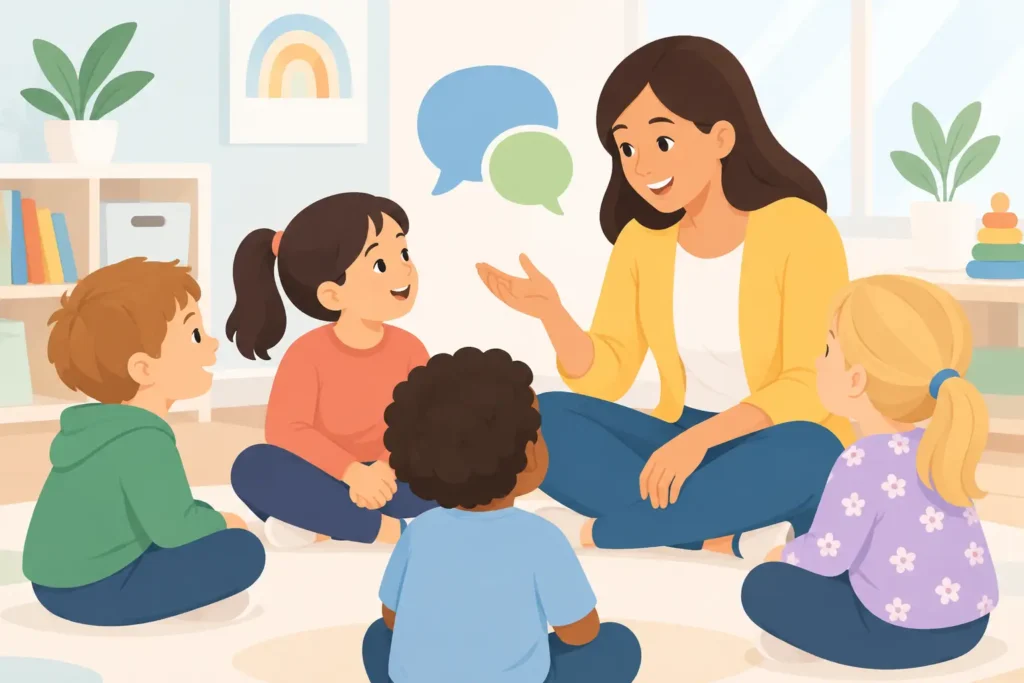
A child who says very little at pickup may have spent the whole day learning, laughing, building, and observing. Preschoolers often need time, safety, and the right invitation before they can turn their experiences into words. Learning how to improve preschool communication is not about asking children to speak more. It is about helping them feel heard, understood, and confident enough to share what is on their minds.
For young children, communication includes much more than clear sentences. A thoughtful pause, a point toward a favorite book, an excited squeal during water play, or a worried face when a toy is taken all communicate something meaningful. When adults respond with patience and warmth, children learn that their voice matters.
Start With Connection, Not Questions
Parents naturally want to know how a child’s day went. Yet the familiar question, “What did you do today?” can feel too big for a tired preschooler. After a full day of learning and play, many children need a snack, a cuddle, or a few quiet minutes before they are ready to talk.
Try sitting beside your child during a calm moment and commenting on what you notice: “You seem happy today,” or “I can see you worked hard on that painting.” A simple observation is often easier for a child to respond to than a direct question. If they do begin sharing, resist the urge to rush into the next question. A pause tells them there is room for their thoughts.
Specific, gentle prompts can also help. Ask, “Who made you laugh today?” “What did you build outside?” or “Was there something tricky that you kept trying?” These questions invite real stories rather than a quick “fine.”
Make Everyday Talk Part of the Routine
Children build language through hundreds of small exchanges. The car ride, bath time, dinner preparation, and getting dressed are all rich opportunities for conversation. The goal is not to turn home into another classroom. It is to let language live naturally inside family life.
While preparing dinner, describe what is happening: “I am slicing the red pepper. It feels crunchy.” Then invite your child to join in at their level: “Can you help me find three mushrooms?” During a walk, notice the clouds, a noisy truck, or a tiny insect on a leaf. New words become easier to remember when children can see, touch, hear, or experience what they mean.
Children also benefit when adults expand what they say. If your child says, “Dog run,” you might respond, “Yes, the brown dog is running very fast to catch the ball.” This gently models longer sentences and richer vocabulary without correcting or pressuring them.
Read Together in a Way That Invites Conversation
Reading is one of the most joyful ways to strengthen communication, especially when the story becomes a shared conversation rather than a performance. You do not need to read every word on every page. Preschoolers often learn just as much from looking closely at pictures, predicting what may happen, and connecting a character’s feelings to their own.
Pause occasionally and ask, “What do you think she will do next?” or “How do you think he feels?” If your child points instead of answering, put language to their idea: “You noticed the bear is hiding behind the tree.” This shows them that gestures and words can work together.
Re-reading favorite books is valuable, even when adults are ready for something new. Familiar stories help children anticipate language, retell events, and speak with growing confidence. A child who joins in with one repeated phrase today may soon begin telling the whole story tomorrow.
Use Play to Build Confidence With Words
Pretend play gives children a comfortable place to practice communication because there is no single right answer. A cardboard box can become a bus, a restaurant, a doctor’s office, or a rocket ship. As children take on roles, they learn how to ask for help, explain a plan, negotiate with friends, and express feelings.
You can support play without taking it over. Follow your child’s lead and add a simple prompt: “The customer is hungry. What should we cook?” or “Uh-oh, the teddy bear fell down. How can we help?” Let your child decide what happens next. Their ideas matter more than a polished storyline.
Hands-on projects offer the same opportunity. Baking, making a floating boat, planting seeds, or sorting buttons by shape and color naturally creates reasons to talk. Children can describe what they see, share a prediction, and explain what changed. When learning feels active and joyful, language often follows.
Help Children Name Feelings and Needs
Clear communication is closely tied to emotional growth. A preschooler who can say, “I am frustrated,” “I need a turn,” or “That scared me,” has more tools to handle difficult moments than a child who can only cry, grab, or withdraw.
Start by naming emotions in everyday situations. “You are disappointed that playtime ended,” is more helpful than simply saying, “Don’t cry.” Naming the feeling does not mean agreeing to every request. It means showing your child that feelings are safe to recognize and discuss.
Offer short phrases they can use with others: “Can I have a turn when you are done?” “Please stop, I do not like that,” and “Can you help me?” Practice these words during calm moments, not only in the middle of a conflict. Over time, children begin to use language before frustration becomes overwhelming.
How to Improve Preschool Communication With Peers
Talking with adults and talking with other children are different skills. At preschool, children are learning how to enter a game, wait for a response, listen to another idea, and recover when a friend says no. These lessons take time, and occasional disagreements are part of the process.
At home, role-play common social moments with stuffed animals or dolls. One toy can ask to join a block tower, while another practices answering kindly. Keep it light and playful. Children are more likely to remember a phrase they practiced during play than one delivered as a lecture.
It also helps to avoid labeling a child as “shy.” Some children are naturally cautious in new groups and need more time to watch before joining in. Instead, describe what you see: “You like to look around first,” or “You are getting comfortable.” This respects their temperament while leaving room for growth.
Create Space for Home and School to Work Together
Communication grows best when children receive consistent, caring support from the adults around them. Share useful details with your child’s teachers, such as a new sibling, a recent move, a favorite interest, or a phrase your child has been practicing at home. Teachers can use that knowledge to make connections and invite participation in a natural way.
Likewise, ask educators about more than worksheets or milestones. Questions such as “When does my child talk most freely?” “Who do they enjoy playing with?” and “What helps when they are upset?” can reveal valuable patterns. A child may be quiet during group time but highly expressive while building outdoors or helping prepare a practical project.
At Summer Tots, purposeful play, reading, outdoor experiences, and hands-on activities create many gentle reasons for children to express ideas, solve small problems, and connect with friends. The most helpful school-home partnership is not about expecting identical routines. It is about sharing the same message: your thoughts are welcome here.
Keep Expectations Kind and Realistic
Children develop communication at different speeds. Some talk early and often; others listen carefully for a long time before they begin using many words. A quiet child is not necessarily unhappy, and a talkative child may still need help listening or taking turns.
What matters most is progress over time. Notice the small wins: a new word, a longer sentence, a child who asks for help instead of crying, or a child who tells a friend, “You can play with me.” These are meaningful signs of growing confidence.
If you are concerned because your child rarely responds to sounds or voices, loses skills they once had, seems unable to understand simple directions, or remains very difficult for familiar adults to understand, speak with your child’s pediatrician. Early guidance can bring reassurance and, when needed, helpful support.
The loveliest conversations with young children are rarely perfect or predictable. They happen while tying shoes, stirring batter, watching rain on a window, or listening to a bedtime story for the tenth time. Stay close, listen patiently, and let your child know that every attempt to communicate is worth hearing.