
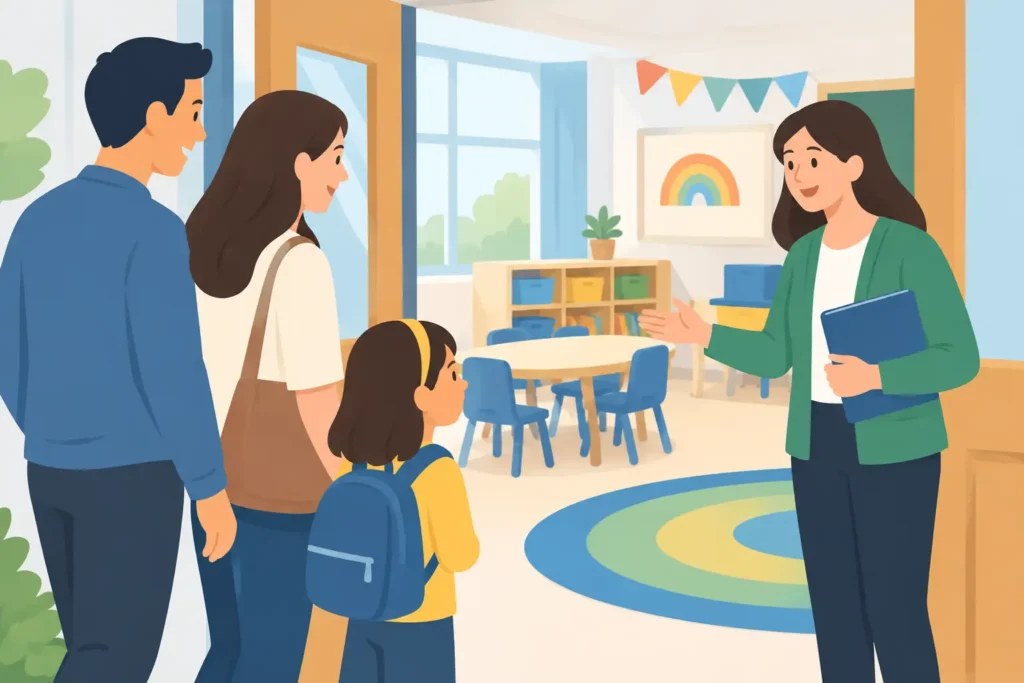
The first kindergarten open house can feel surprisingly emotional. You may be picturing your child hanging up a tiny backpack, making new friends, and taking those first proud steps toward independence. At the same time, you are trying to make a thoughtful choice about where they will spend so much of their day. This guide to kindergarten open houses can help you look beyond cheerful walls and polished displays to see whether a school will truly help your child grow with happy hearts and healthy minds.
Start With How Your Child Feels in the Space
Before asking about curriculum or enrollment, pause and notice the atmosphere. Does the school feel calm, warm, and welcoming? Are children greeted by name? Do teachers kneel down to speak at a child’s level, listen patiently, and offer gentle encouragement?
Young children learn best when they feel safe enough to try, ask questions, make mistakes, and begin again. A beautiful classroom matters, but a caring emotional environment matters even more. Notice whether the children you see appear comfortable and engaged. Some may be busy building, painting, reading, or playing outdoors. Others may be quietly watching at first. Both are perfectly normal. What you want to see is adults who understand each child’s personality and know how to bring them into the day with kindness.
A school should feel like a safe haven, not a place where children are expected to grow up too quickly. Ask yourself: Can I imagine my child being comforted here on a difficult morning? Can I imagine them coming home excited to share something they discovered?
What to Look for at Kindergarten Open Houses
An open house gives you a glimpse of a school, but the best questions help you understand what happens after the visit is over. Look closely at how the setting supports the whole child – their confidence, language, physical health, friendships, curiosity, and early academic skills.
Look beyond worksheets
Kindergarten readiness includes recognizing letters and numbers, listening to stories, holding a pencil, and beginning to communicate ideas clearly. But children also need to take turns, manage small frustrations, follow routines, and ask for help when they need it.
Ask how learning is introduced throughout the day. A thoughtful program will balance purposeful instruction with hands-on play. Children may develop early math skills while creating geometric shapes, practice language while making a class book, or explore science by observing water vapor, planting seeds, or building floating boats. These experiences give learning meaning. Instead of simply memorizing an answer, children have a chance to wonder, test, talk, and create.
Academic readiness and joyful learning do not compete with one another. In fact, children often build stronger foundations when they are actively involved in what they are learning.
Notice the room to move
Young children are not meant to spend every hour sitting still. Outdoor play, movement games, climbing, balancing, and imaginative play all support coordination, confidence, concentration, and emotional well-being.
During your visit, ask how often children go outdoors and what they do there. A small outdoor area can still be used thoughtfully, while a larger playground is only valuable if children have regular, supervised opportunities to explore it. You may also want to ask what happens on rainy days. Schools that value active children usually have a plan for indoor movement and play as well.
See whether children’s work is valued
Look at the displays on the walls. Are they all identical crafts made from a teacher’s model, or do you see children’s individual ideas, drawings, writing attempts, photographs, and project work? There is nothing wrong with a seasonal art activity, but children also deserve opportunities to make choices and express themselves.
A nurturing kindergarten celebrates progress, not perfection. A wobbly letter, an inventive drawing, or a carefully built block tower can tell a teacher a great deal about a child’s development. When educators pay attention to these small moments, families receive a clearer picture of how their child is growing.
Questions That Reveal the Daily Experience
It is easy to feel shy about asking questions during an open house, especially when other parents are waiting. Remember that this is your opportunity to learn how the school will care for your child. You do not need to ask everything at once, but a few thoughtful questions can reveal a great deal.
Ask how teachers help a child settle in during the first weeks. Starting kindergarten is a major transition, and children adjust at different speeds. Some are ready to join a group on day one, while others need extra reassurance, a familiar routine, or a quiet moment with a trusted adult.
Ask about teacher communication, too. Working parents especially need to know how they will hear about meals, rest, activities, friendships, challenges, and milestones. The right approach depends on your family. Some parents appreciate brief daily updates, while others prefer a regular conversation and a more detailed progress report. What matters is that communication is respectful, consistent, and two-way.
You can also ask how the school handles conflict between children. Preschool and kindergarten are important places for learning kindness, empathy, and respect. Children will occasionally disagree over toys, space, or rules. A caring teacher does not simply stop the behavior. They guide children to name feelings, listen, repair, and try a better choice next time.
Consider the Practical Details With Confidence
A school may offer a wonderful classroom experience, but the daily routine must also work for your family. Ask about arrival and pickup procedures, security, meals, rest time, health practices, and who is authorized to collect your child. Clear routines protect children and give parents peace of mind.
If you need extended care, explore what those hours actually look like. Are children supervised by familiar educators? Is there time for rest, outdoor activity, reading, and relaxed play after structured learning? Extended day care should feel like a continued part of a child’s day, not simply time spent waiting for pickup.
It is also helpful to ask about class size and staffing. There is no single perfect number because children’s ages and needs vary. Still, teachers should have enough support to observe children closely, respond warmly, and offer individual guidance. A child who is shy, highly active, still developing English skills, or adjusting to a new routine may need different support than another child. A good school sees those differences as part of caring for the whole child.
Bring Your Child, but Follow Their Lead
If the school allows children to attend, bringing your child can be helpful. Watch what draws their attention. Do they head for the books, the play kitchen, the art table, the blocks, or the outdoor space? Their choices can start a useful conversation afterward.
At the same time, do not expect a final decision from one visit. A child may cling to you in an unfamiliar place and still thrive there once they know the teachers and routine. Another child may run in confidently but need more support after the first few days. Their reaction is one piece of information, not the entire answer.
Afterward, keep the conversation simple. Ask what they liked, who they met, or what they would like to try next time. Avoid turning the visit into a test. The goal is to help your child feel included in a family decision while reassuring them that you will be there to guide the transition.
Trust Evidence, Not Just First Impressions
Warm greetings and attractive facilities are lovely, but look for evidence of thoughtful care. Listen to how educators talk about children. Do they describe them as individuals with strengths, interests, and developing skills? Can they explain how play supports reading, communication, problem-solving, and confidence?
At Summer Tots, families are encouraged to look for a setting where children can learn through stories, practical projects, outdoor discoveries, and meaningful relationships with experienced educators. Whether a child is baking, observing nature, creating, or sharing a book with a teacher, these everyday moments can build the confidence that supports future learning.
The right kindergarten will not promise that every day is perfect. Children may have tired mornings, friendship struggles, or moments when a new skill feels hard. What matters is whether the adults respond with patience, structure, affection, and a genuine belief in your child’s potential.
As you leave an open house, notice the feeling you carry home. The best choice is often the school where you can picture your child being known, encouraged, and cared for – while gradually becoming more capable of doing wonderful things on their own.