
A child who comes home proudly using a new English phrase, sings a classroom song at dinner, or asks to read the same story again is showing more than language progress. They are showing comfort, connection, and confidence. When considering English immersion versus bilingual preschool, the best choice is rarely about choosing the “better” model. It is about finding the environment where your child feels safe enough to speak, play, ask questions, and grow.
For families in Kuala Lumpur, English can open doors in future schooling and everyday communication. At the same time, a child’s home language carries family stories, affection, identity, and a precious sense of belonging. A thoughtful preschool should respect both the child in front of them and the hopes their family holds for the future.
English Immersion Versus Bilingual Preschool: The Core Difference
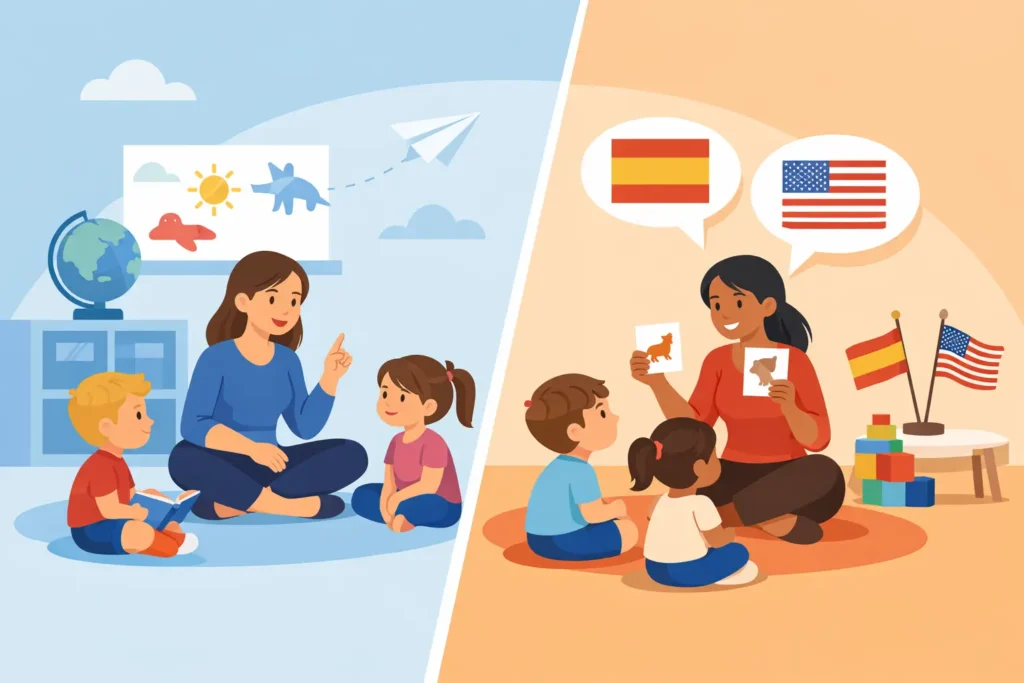
An English immersion preschool uses English as the main language for classroom life. Teachers give directions, tell stories, lead songs, guide play, and introduce early literacy in English. Children hear the language repeatedly in meaningful moments, such as measuring flour while baking, negotiating turns at the water table, or explaining why a handmade boat floats.
A bilingual preschool intentionally uses two languages for learning and communication. The exact balance varies. Some programs divide the day between languages. Others have different teachers for each language, or introduce one language during selected activities. The aim is to help children develop understanding and expression in both languages from an early age.
Neither approach is automatically right for every child. What matters is how naturally language is woven into a warm, well-planned day, and whether teachers respond patiently to each child’s stage of development.
What English Immersion Can Offer Young Children
For a preschooler, immersion does not need to feel like a language lesson. In a nurturing English-led classroom, children learn because English is part of something enjoyable and real. They hear words while planting seeds outdoors, make predictions during a simple science activity, and build vocabulary while preparing pizza or creating shapes from craft materials.
This steady exposure can help children become familiar with English sounds, everyday phrases, and classroom routines. Over time, many children begin to respond in English, first with gestures or single words and later with fuller sentences. They may gain confidence listening to teachers, joining group conversations, and sharing their ideas.
English immersion can be especially appealing for families who expect English to be the primary language of their child’s future school. It may support a smoother transition into English-medium instruction, early reading activities, and friendships with children from different language backgrounds.
Still, a quality immersion program should never expect instant speaking. Some children need weeks or months to observe, understand, and feel secure before they use many English words aloud. Quiet listening is often part of learning, not a sign that a child is being left behind.
The emotional piece matters
Young children learn language through relationships. A teacher’s gentle encouragement, familiar routines, expressive storytelling, and willingness to wait for a child’s answer all make a difference. When children feel accepted, they are more likely to take the small, brave risks that language learning requires.
Look for educators who use visual cues, songs, gestures, hands-on materials, and repetition without making children feel corrected or pressured. A child who feels safe can say, “Can I try?” even before they have all the words.
What a Bilingual Preschool Can Offer
A bilingual program may be a wonderful fit for families who want their child to build English skills while maintaining a strong connection to another language. This can be particularly meaningful when grandparents, relatives, or the wider family use that language at home.
Children in a well-run bilingual preschool can learn that different languages belong in different places and relationships. They may sing a song in one language, enjoy a story in another, and gradually understand that both are valuable ways to connect with people. This can strengthen a child’s sense of identity and help preserve communication across generations.
The trade-off is that English exposure may be less concentrated than in a full English-immersion setting, depending on the schedule. For children who have limited English outside school and will soon enter an English-led primary program, parents may want to ask how much meaningful English conversation, storytelling, and early literacy experience takes place each day.
A bilingual label alone does not tell the whole story. The quality of teacher interaction, the consistency of each language, and the child’s opportunities to actively use both languages matter far more than the name of the program.
How to Choose for Your Child and Family
Start by thinking about your child’s current experience, not only long-term goals. Does your child already hear and understand English at home? Are they comfortable in new groups, or do they take time to warm up? Is there a family language you want them to use confidently with loved ones? These answers can point you in a helpful direction.
Then consider the school day as a whole. Preschool is not simply preparation for future worksheets or language tests. It is where children learn to separate from parents with confidence, share space with friends, recover from disappointment, care for materials, and feel proud of what they can do.
A strong program, whether immersion or bilingual, gives children many reasons to communicate. They should have time for imaginative play, outdoor movement, music, art, practical projects, and shared reading. A child who observes water vapor, helps care for chicks, or makes sushi with classmates has something meaningful to talk about. Language grows best when it has a purpose.
Questions worth asking during a school visit
During a visit, notice whether children seem relaxed and engaged. Are teachers speaking kindly at a level children can understand? Do they kneel down to listen? Are quieter children gently included, while more talkative children are guided to listen and take turns?
Ask how the school supports a child who is new to English or reluctant to speak. Find out how teachers share progress with parents, how they encourage early reading, and how they handle the first few weeks of settling in. For working parents, it is also worth asking how extended day care continues the same caring routines rather than feeling like a separate, less structured part of the day.
You may also ask how the school supports home languages. An English-led school does not need to treat other languages as a problem. The most caring educators recognize that a strong foundation in a child’s home language can coexist with joyful English learning.
Supporting Language Growth at Home
Your home does not need to become another classroom. The most valuable support comes from regular, happy conversation. Speak with your child in the language that feels most natural and emotionally rich to your family. Tell stories about your day, name feelings, sing songs, cook together, and make room for your child’s questions.
If your child attends an English immersion program, you can invite English into everyday moments without turning it into a test. Read a favorite English picture book together, repeat songs they enjoy at school, or ask simple questions such as, “What did you build today?” If they answer in another language, respond warmly. Understanding and confidence often come before fluent speaking.
Avoid comparing your child to siblings or classmates. One child may begin speaking English quickly, while another listens carefully for a long time before surprising everyone with a complete sentence. Both paths can be healthy when the child is supported with patience.
The Best Choice Feels Like a Partnership
The decision between English immersion and bilingual preschool becomes clearer when you look beyond the timetable. Your child needs adults who know their name, notice their feelings, celebrate their efforts, and guide them with kindness. They need a safe haven where learning includes books and letters, but also muddy shoes after outdoor play, proud smiles after finishing a project, and friendships built one shared activity at a time.
At Summer Tots, English-led learning is designed to grow alongside curiosity, character, practical discovery, and joyful play. The goal is not to rush children into performing. It is to help them become confident communicators with happy hearts, healthy minds, and a genuine readiness to keep learning.
Choose the setting where your child is welcomed warmly, understood as an individual, and given many small chances to say, “I can do it.” Those moments will carry far beyond preschool.