
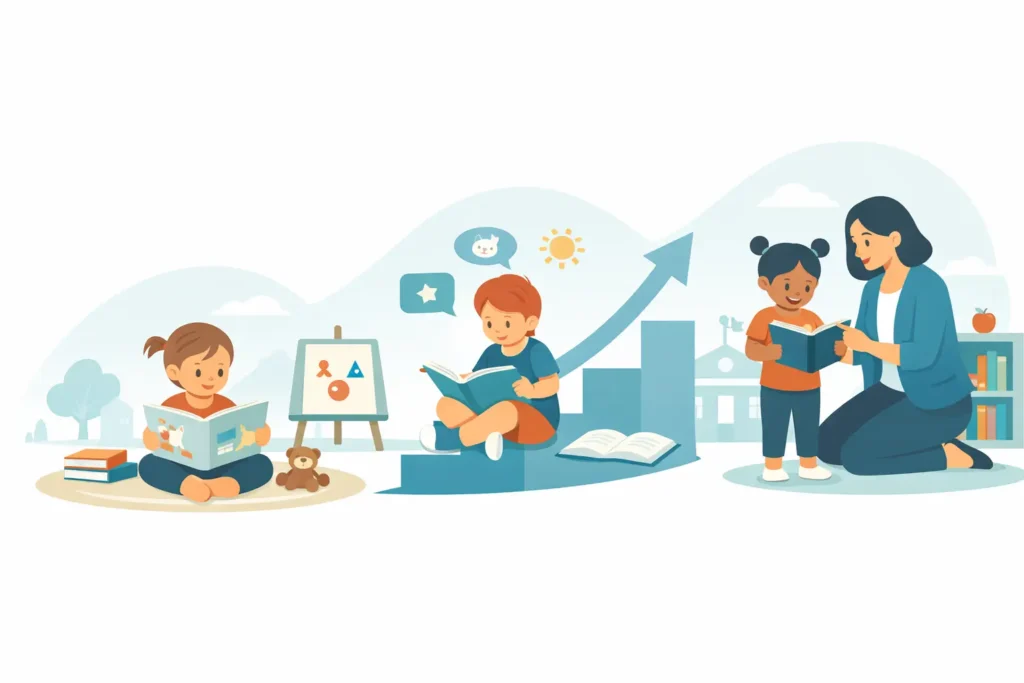
A child who proudly recognizes the first letter of their name is not simply learning an alphabet fact. They are beginning to understand that marks on a page carry meaning. Early reading milestones grow through hundreds of small, joyful moments: a favorite bedtime story, a rhyme repeated in the car, a sign noticed on the way to school, or a teacher pausing to ask, “What do you think happens next?”
For parents, it can be reassuring to know that reading development does not begin when a child reads a whole book aloud. It starts much earlier, with language, listening, curiosity, and the confidence to share an idea. Every child develops at a different pace, but a nurturing environment can make the journey feel safe, engaging, and full of possibility.
What early reading really looks like
Early reading is much more than memorizing letters or completing worksheets. Before children can decode words, they need rich experiences with spoken language. They need to hear stories, learn new words, notice sounds, and discover that books can make them laugh, wonder, imagine, and feel understood.
A preschooler may “read” a familiar story by turning pages and retelling it from memory. Another child may point to a logo and recognize it. A child who says that cat and hat sound alike is also building a valuable foundation. These moments may look simple, but they show that a child is connecting sounds, pictures, words, and meaning.
The goal is not to rush children into formal reading before they are ready. The goal is to help them become eager, capable learners who see books and language as friendly parts of daily life.
Early reading milestones by age and stage
Milestones are helpful guideposts, not a race. A child may be especially confident with storytelling but still need time with letter names. Another may recognize many letters yet be quieter during group discussions. Looking at the whole child gives a clearer picture than focusing on one skill alone.
Around ages 2 to 3: Listening, talking, and loving books
At this stage, children often begin to choose favorite books and request the same story again and again. Repetition is not a sign that they are bored by other books. It helps them absorb language patterns, remember new words, and predict what comes next.
Many children can hold a book the right way up, turn pages one at a time, point to familiar pictures, and join in with repeated phrases. They may sing parts of nursery rhymes or notice sounds in everyday words. Strong early reading foundations at this age come from conversation. Naming objects while cooking, talking about the weather, and listening patiently to a child’s own stories all matter.
Around ages 3 to 4: Rhymes, sounds, and print awareness
Preschool-age children often begin to understand that print is different from pictures and that we read words in an organized direction. They may recognize their own name, identify a few letters, or notice letters on labels and signs.
Rhyming becomes especially useful during this stage. When children hear that sun, fun, and run share a sound, they are developing phonological awareness, which means noticing the sounds within language. Clapping syllables in names, stretching out the first sound in “mmmom,” and playing silly rhyming games can build this awareness without making learning feel like a test.
Children also benefit from being asked open questions about stories. Instead of only asking, “What color is this?” try, “Why do you think the bear feels sad?” Their answer does not need to be perfect. The conversation develops comprehension, vocabulary, and confidence.
Around ages 4 to 5: Connecting letters and sounds
As children approach kindergarten, many begin to recognize more uppercase and lowercase letters, especially those in their name. They may connect some letters to their sounds, such as knowing that B can begin the word ball.
Some children start blending simple sounds into words, while others are still strengthening listening skills and letter recognition. Both can be appropriate. Reading readiness depends on many things, including language exposure, confidence, attention, and whether a child has had meaningful experiences with books.
At this stage, writing and reading often support one another. A child who draws a picture and explains, “This says my grandma is baking,” is learning that spoken ideas can be represented on paper. Scribbles, invented spelling, and attempts to write a name are all worthwhile steps.
Kindergarten readiness: Making meaning from words
By kindergarten, children are often ready to build greater independence with books. They may recognize common words, sound out simple words, retell key events, and answer basic questions about a story. Just as importantly, they are learning to stay with a book, use pictures for clues, and talk about what they have heard or read.
A child who reads slowly but understands and enjoys the story is making meaningful progress. Speed should never be the only measure. Reading is ultimately about meaning, imagination, and communication.
Gentle ways to support reading at home
The most effective reading support usually fits naturally into family life. Ten attentive minutes with a book can be more valuable than a long lesson when everyone is tired.
Create a small, inviting reading space where books are easy for your child to reach. Include familiar favorites as well as books about animals, families, feelings, vehicles, nature, and everyday routines. Let your child choose sometimes, even when they choose the same book for the tenth night in a row.
When you read together, point out the title, the author’s name, and a few interesting words. Pause before turning the page and invite your child to guess what may happen. Use expressive voices, laugh at funny moments, and allow your child to interrupt with their own ideas. A story shared with warmth teaches children that reading is a pleasure, not a performance.
Everyday activities can also become literacy moments. Let your child help find the first letter on a grocery list, spot a familiar word on a package, or describe the steps while making pizza, sushi, or a simple snack. After an outdoor walk, encourage them to draw what they saw and tell you about it. These experiences build vocabulary and give children something meaningful to talk and write about.
Screens can have a place in family life, but they work best as a complement rather than a replacement for real conversation and shared books. Young children learn deeply from eye contact, questions, gestures, and the comfort of reading beside a caring adult.
When a child needs a little more support
Children develop on different timelines, and a slower start does not automatically mean there is a problem. Bilingual children, for example, may be building knowledge across more than one language, which is a strength. They may need time to show their full vocabulary in each language.
Still, it is worth speaking with your child’s teacher or health professional if they rarely show interest in books, struggle to understand simple directions, have difficulty hearing or producing sounds, or become consistently frustrated by language activities. Early support can be gentle and highly effective, especially when families and educators work together.
A caring preschool can help by observing how a child listens, speaks, joins conversations, handles books, and responds to sound and letter activities. At Summer Tots, reading development can be woven into storytelling, purposeful play, practical projects, outdoor discoveries, and warm one-to-one encouragement. This allows children to learn in ways that feel natural to them while educators share meaningful progress with families.
A confident reader begins with a happy learner
The early years are not about producing the youngest reader in the room. They are about helping a child feel heard, capable, and excited to discover what words can do. When books are connected to cuddles, laughter, questions, nature walks, and imaginative play, children begin to carry that positive feeling forward.
Keep reading together, keep talking, and celebrate each small step. A child’s growing relationship with language is one of the loveliest things a family and school can nurture together.