
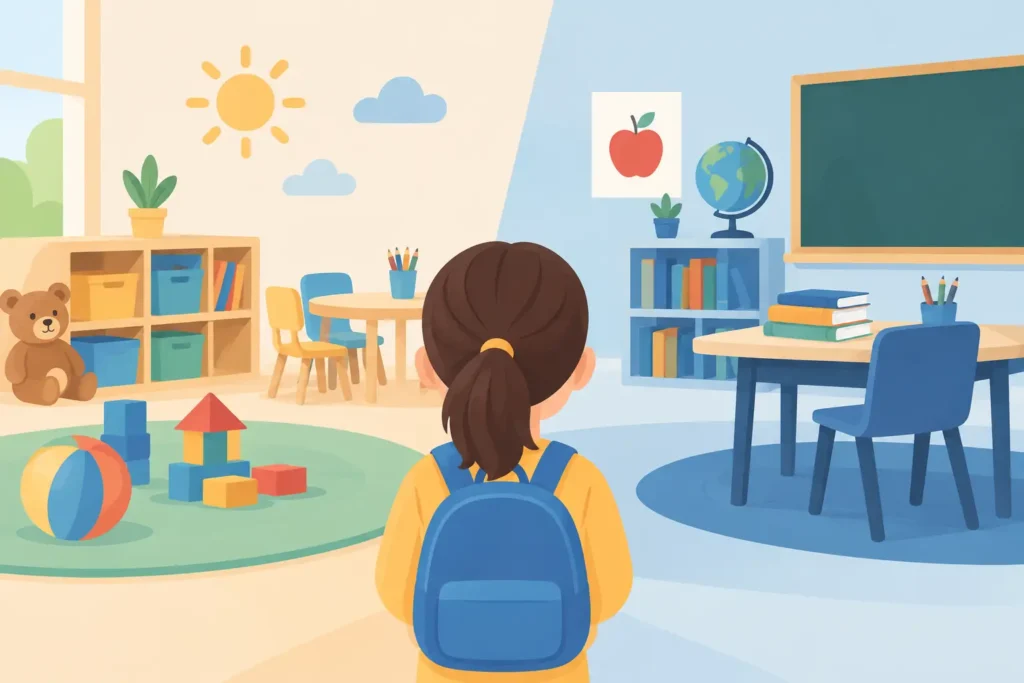
A child proudly sounding out a new word, asking why ice melts, or inviting a classmate into a game is learning something meaningful. For parents weighing play school versus academic preschool, the real question is not whether children should learn. It is how they can learn in a way that protects their joy, builds confidence, and prepares them for the next stage of school.
Many families want to see clear progress in letters, numbers, writing, and English communication. They also want their child to feel safe at school, make friends, manage emotions, and come home happy. These hopes do not compete with one another. The strongest early learning environments make room for both purposeful teaching and the kind of play that helps young children understand the world.
What Is the Difference Between Play School and Academic Preschool?
A play school, often called a play-based preschool, uses guided play, movement, stories, art, outdoor time, music, and hands-on projects as important ways to learn. Children may practice counting while setting a table for a pretend café, strengthen hand control while molding clay, or develop language while explaining how they built a boat that floats.
An academic preschool usually places more emphasis on structured lessons, worksheets, early reading, writing practice, and direct instruction. There may be a clear daily focus on phonics, number work, spelling, or completing assigned tasks. This approach can feel reassuring to parents who want visible academic results and a familiar classroom routine.
Neither label tells the whole story. A joyful classroom can teach phonics carefully. A structured classroom can include excellent play. What matters is the balance: whether learning is suited to a young child’s development, whether educators respond to each child’s needs, and whether academic goals are built on genuine understanding rather than pressure.
Play School Versus Academic Preschool: The Trade-Offs
Play-based learning is sometimes misunderstood as free time without direction. Quality play-based education is very different. Educators prepare inviting spaces, observe closely, ask thoughtful questions, introduce new vocabulary, and extend children’s ideas. A child making geometric shapes with craft sticks is exploring math. A group baking muffins is measuring, taking turns, following steps, and using language.
This approach is especially valuable because young children learn with their whole bodies and all their senses. They need opportunities to touch, test, move, talk, imagine, and try again. When a child watches water vapor form, cares for newly hatched chicks, or creates a pizza with friends, the experience gives words and ideas a lasting meaning.
Academic preschool can offer benefits too. Some children enjoy predictable routines and feel proud when they master letter sounds, read a simple book, or write their name independently. Direct teaching can be helpful when it is short, warm, and connected to what children already know. It can also ensure that literacy and numeracy receive steady attention rather than being left to chance.
The concern comes when formal work takes up too much of the day or expects children to perform before they are ready. Long periods of sitting, repetitive worksheets, and comparison with classmates can make learning feel stressful. A child may memorize a sequence of letters yet hesitate to speak up, solve a problem with a friend, or take a healthy risk in a new activity.
For preschool-age children, readiness is broader than being able to complete a page of work. It includes listening to instructions, expressing needs, waiting for a turn, recovering from disappointment, caring for belongings, and believing, “I can try.” These are not extras. They support every future academic skill.
The Best Early Education Is Purposeful, Not Pressured
Parents do not have to choose between a cheerful childhood and meaningful school preparation. A balanced program can offer both. Children can enjoy outdoor play and still develop early literacy. They can explore practical projects and still learn to recognize numbers, follow routines, and communicate in English.
Purposeful learning often begins with a child’s curiosity. If children are fascinated by boats, an educator can invite them to predict which materials will float, draw their designs, compare sizes, and describe what changed after each test. The activity feels like play, but it develops scientific thinking, vocabulary, persistence, and early writing.
Reading development also benefits from this balance. Children need stories read aloud with warmth and expression, time to talk about characters, songs and rhymes that help them hear sounds in words, and guided opportunities to connect sounds with letters. They also need fine-motor experiences such as painting, cutting, threading, and building before being asked to write for long periods.
When literacy is introduced through meaningful experiences, children are more likely to see reading and writing as useful, enjoyable ways to share ideas. When it is taught only as a task to finish, they may focus on getting the answer right rather than becoming curious readers.
Questions to Ask When Visiting a Preschool
A school visit can reveal much more than a brochure. Notice how the children are greeted, how educators speak to them, and whether the classroom feels calm, active, and welcoming. A good early childhood setting should feel like a safe haven where children are known as individuals, not simply managed as a group.
Ask how the school supports literacy, early math, language, and kindergarten readiness. Then ask how children spend the rest of their day. Is there time for outdoor activity, imaginative play, stories, practical projects, and conversation? Are children encouraged to ask questions and make choices within clear, caring boundaries?
It also helps to understand how educators respond when a child is shy, upset, struggling with a skill, or having difficulty with another child. Young children need adults who guide behavior with patience and consistency. Character education is lived in these everyday moments: learning to apologize, include others, use kind words, and respect shared spaces.
For working parents, practical care matters as much as philosophy. Ask about arrival and pickup routines, supervision, meals, rest, communication with families, and extended day-care support. A dependable schedule and secure environment allow children to settle, while regular updates help parents remain connected to their child’s growth.
Consider Your Child, Not Just the Label
Every child brings a different temperament to school. A highly social child may thrive in group projects and dramatic play. A cautious child may need time to observe before joining in. A child who loves books may welcome early reading lessons, while another may first need movement, conversation, and sensory experiences to build attention and confidence.
The goal is not to find the most demanding program or the most relaxed one. It is to find a caring environment that sees your child clearly and helps them grow step by step. Look for teachers who can celebrate a child’s strengths while gently supporting the areas that need more time.
At Summer Tots, this balance is reflected in hands-on learning, English-led instruction, outdoor experiences, reading development, and daily guidance in kindness and respect. Children have opportunities to make, investigate, move, imagine, and practice the early skills that will support them in kindergarten. Just as importantly, they are given the reassurance to keep trying.
A preschool should leave room for small, wonderful moments: the child who finally volunteers an answer, the friends who solve a disagreement with help, the first book read with pride, or the muddy shoes after an afternoon of outdoor discovery. Those moments are not separate from preparation for the future. They are where happy hearts and healthy minds begin to grow.